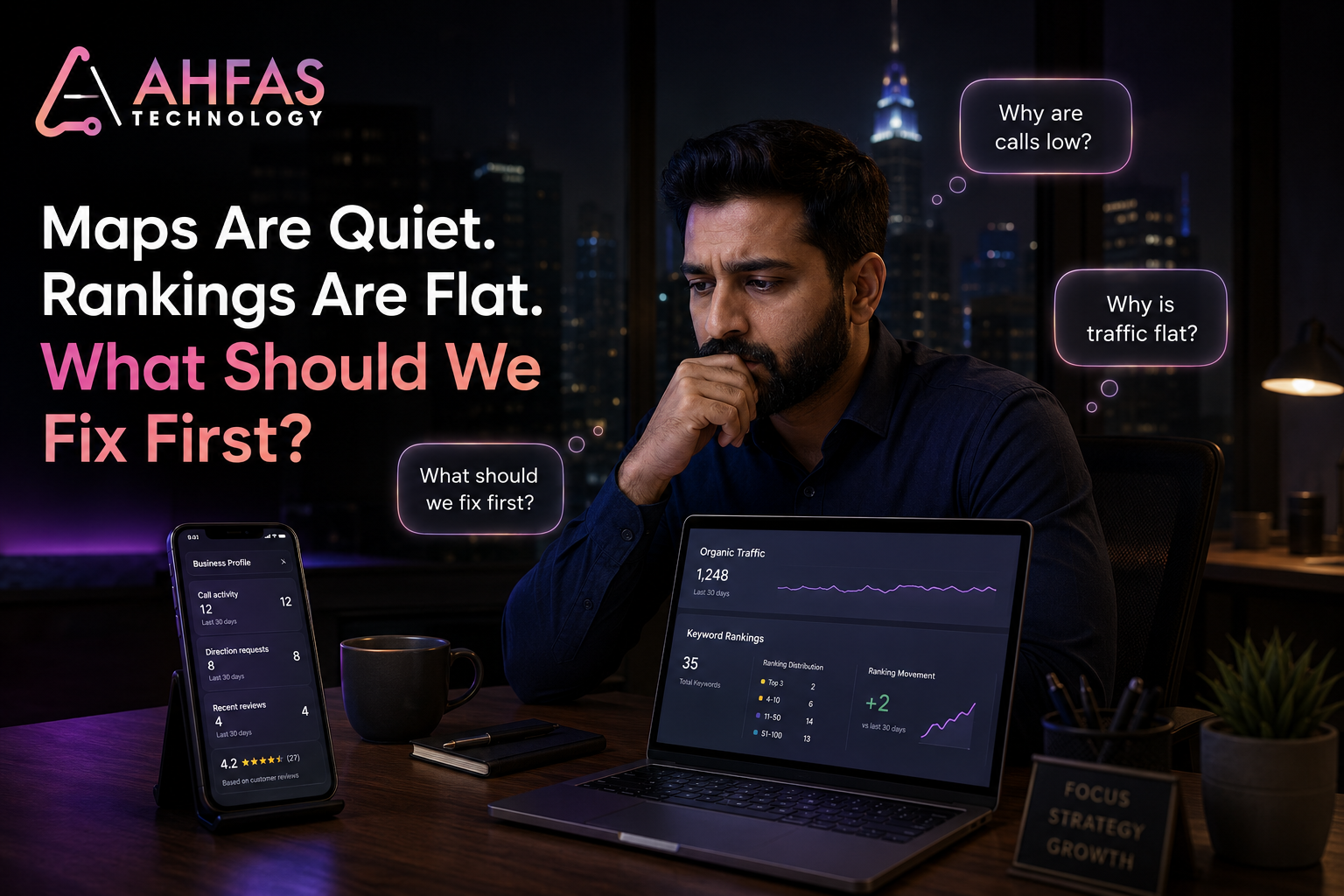
Maps are quiet.
Website rankings are flat.
Budget is tight.
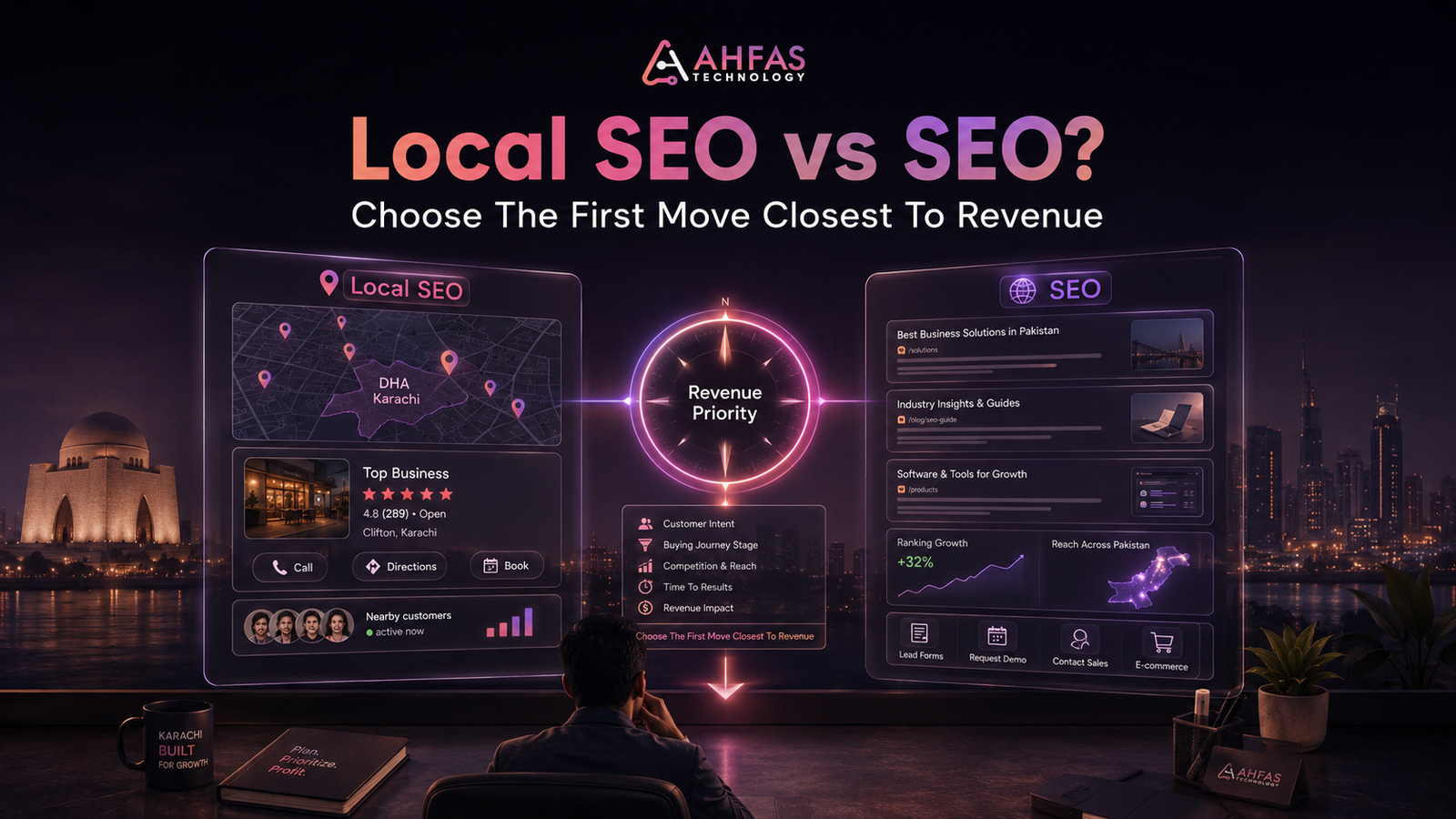
For Karachi businesses comparing local SEO vs SEO, the first choice depends on where customers search and how they buy.
Choose local SEO first when people need a nearby location, directions, calls, visits, or bookings. Choose broader organic SEO first when customers can buy remotely, search from across Pakistan, or discover the business through non-location queries.
Many businesses eventually need both. The mistake is funding both equally before diagnosing which visibility gap is costing opportunities right now.
Key Takeaways
- Local SEO targets nearby demand through Google Maps, the Local Pack, reviews, and location signals.
- Broader SEO targets organic website visibility across Karachi, Pakistan, or wider markets.
- Clinics, restaurants, salons, retailers, and home services usually need local SEO first.
- Ecommerce, software, remote services, and nationwide businesses usually need broader SEO first.
- Weak website pages or an incomplete Business Profile may require foundation work before either campaign can perform.
First, Local SEO Is Still SEO
Local SEO is not a competing replacement for SEO. It is a specialised branch of search engine optimisation built around geographic intent.
The difference lies in the search journey.
Someone searching for “dentist near me” may want directions, opening hours, reviews, and a phone number.
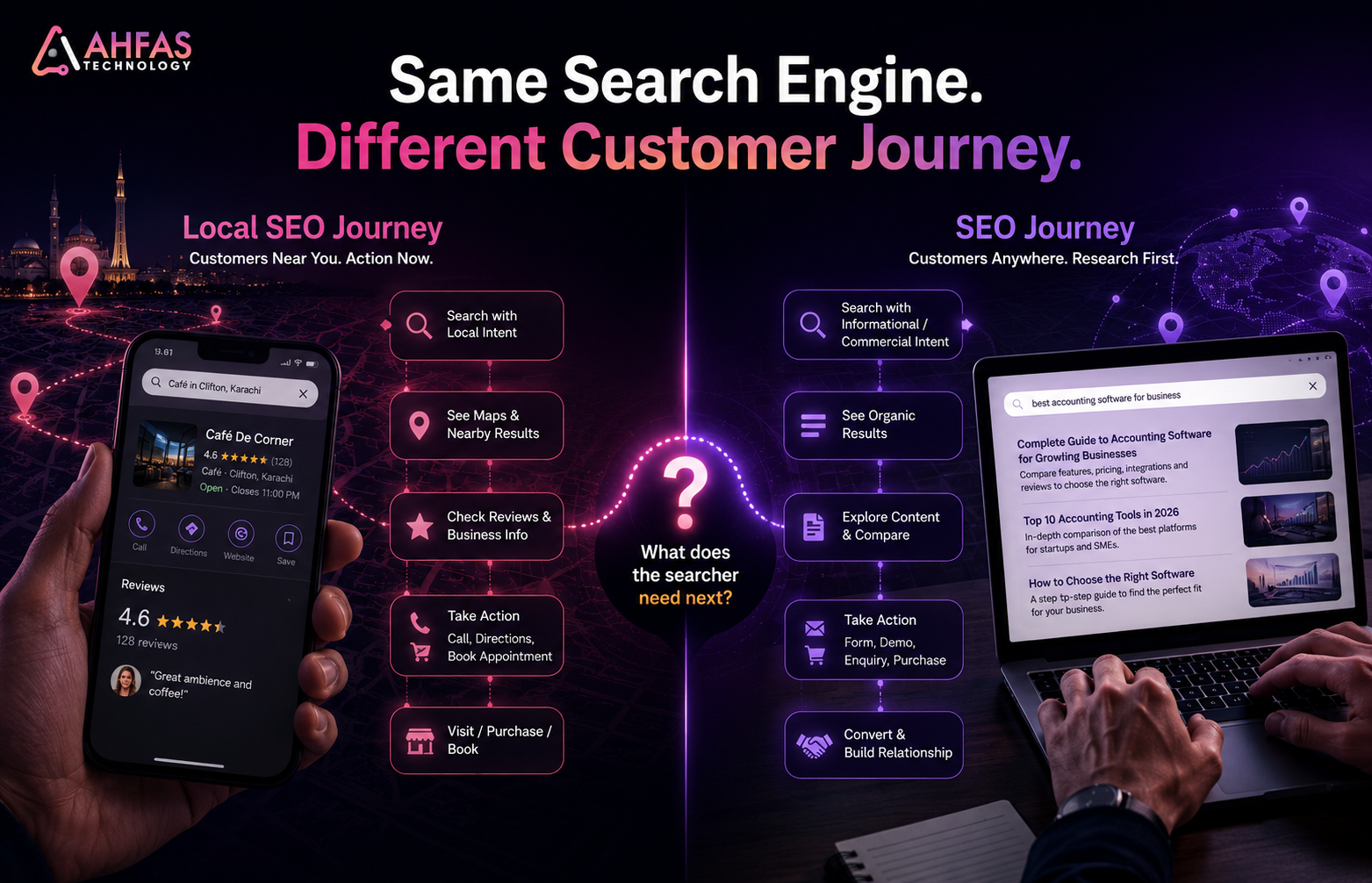
Someone searching for “how to choose dental implants” may want a detailed website guide before contacting anyone.
Local SEO helps a business appear when location matters. Broader organic SEO helps website pages rank when expertise, information, services, or products matter more than physical proximity.
Google’s latest guidance also confirms that the same foundational SEO principles continue to support visibility in AI Overviews and AI Mode. Google recommends valuable content, a clear technical structure, accurate business information, and properly managed Business Profiles rather than separate “AI SEO hacks.” Read Google’s current guidance for generative AI features in Search.
What Is the Difference Between Local SEO and SEO?
The clearest difference is where the business wants to appear and what the searcher wants to do next.
| Factor | Local SEO | Broader Organic SEO |
| Primary audience | Customers near a location or service area | Customers across cities, regions, or countries |
| Main visibility | Google Maps, Local Pack, local organic results | Standard organic website results |
| Search examples | “Cafe in Clifton” or “plumber near me” | “Best accounting software” or “website development guide” |
| Core assets | Business Profile, reviews, local pages, citations | Website content, technical SEO, links, authority |
| Typical actions | Calls, directions, appointments, visits | Traffic, forms, demos, purchases, enquiries |
| Strongest fit | Clinics, restaurants, salons, local services | Ecommerce, software, exporters, remote services |
| Main limitation | Distance from the searcher affects visibility | Wider competition may require more authority and time |
Google states that local results are mainly determined by relevance, distance, and prominence, called “popularity” in some versions of its documentation. Google also makes clear that businesses cannot pay or request a higher organic local position. See Google’s official local ranking guidance.
That distance factor matters. Strong reviews and excellent pages can improve relevance and prominence, but they cannot make a business in Gulshan physically closer to someone searching from Defence.
Why Local Trust Matters More in 2026
People rarely choose a local business from one signal alone.
They may discover a clinic in Maps, read its reviews, open its website, inspect the services, check the address, and then decide whether to call.
BrightLocal’s 2026 Local Consumer Review Survey found that 97% of surveyed consumers read reviews for local businesses. The study used a representative panel of 1,002 US adults, so it should not be treated as Karachi-specific data. It still shows how strongly reviews shape local buying decisions and why a Business Profile without credible customer feedback creates a trust gap.
Reviews alone are not a strategy. They work alongside accurate business information, relevant categories, strong service pages, visible contact options, and a real customer experience worth reviewing.
Which Search Results Does Local SEO Target?
Local SEO targets search experiences where Google detects geographic intent.
These commonly include:
- Google Maps Results
- The Three-Business Local Pack
- Business Profile Panels
- Local Service And Location Pages
- Searches Containing City Or Neighbourhood Names
- “Near Me” And “Open Now” Searches
- Searches Where Distance Affects The Answer
Google Business Profile usually sits at the centre of this system. It helps a business manage how its name, location, hours, phone number, services, photos, reviews, and website appear across Search and Maps.
A profile can create visibility before a person visits the website. But it should not replace the website. Maps may create the first impression, while the website answers the questions that determine whether the person calls.
Which Results Does Broader SEO Target?
Broader SEO targets standard organic results where the searcher does not necessarily need a nearby business.
It usually involves:
- Technical Crawlability And Indexability
- Search-Intent-Based Keyword Research
- Service And Product Pages
- Informational Content
- Internal Linking
- Site Architecture
- Backlinks And Brand Mentions
- Mobile Usability And Core Web Vitals
- Conversion Tracking
- Topical Authority
For example, a Karachi software company targeting clients throughout Pakistan should not limit its strategy to “software company near me.” It needs service pages and useful content that can compete for non-location searches.
Businesses trying to improve website traffic and rankings should also check whether their pages answer the right query. More content will not repair weak search intent, overlapping pages, or an unclear offer.
The Search Radius to Revenue Test
Before choosing a channel, answer these five questions:
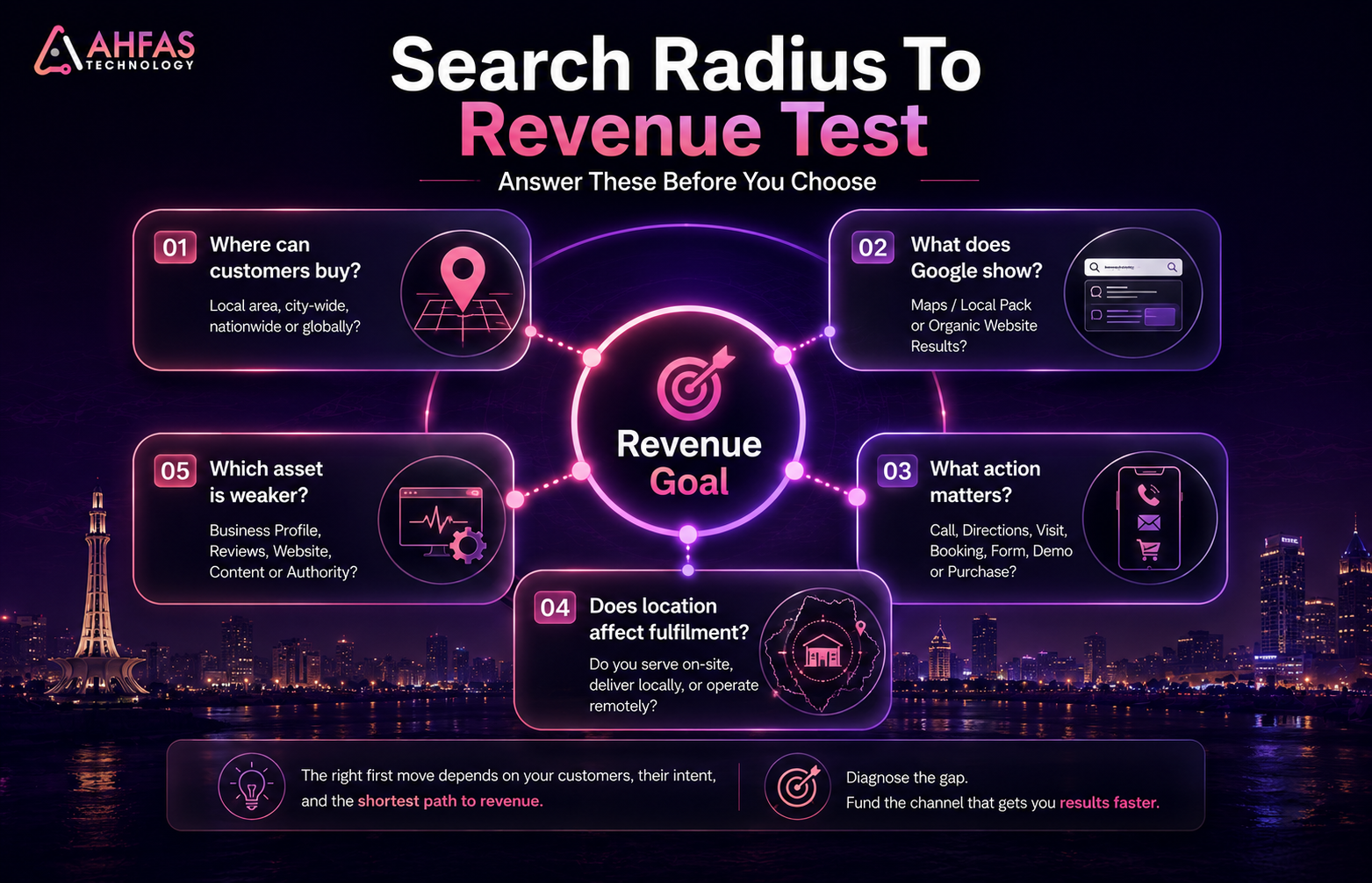
- Where can the customer realistically buy?
One neighbourhood, all of Karachi, Pakistan, or anywhere? - What does Google show for the target query?
Maps, organic pages, shopping results, or a mixture? - What action matters most?
Directions, calls, appointments, forms, demos, or online purchases? - Does location affect fulfilment?
Can the business serve someone outside Karachi? - Which asset is currently weaker?
The Business Profile, local reputation, website, content, or technical foundation?
Michael Porter wrote, “The essence of strategy is choosing what not to do.” That principle fits SEO budgeting perfectly. Choosing one first priority does not mean ignoring the other forever. It means concentrating limited resources where they can solve the most urgent business problem. Porter’s work on strategic choice is documented by Harvard Business School. (Harvard Business School)
When Should Karachi Businesses Choose Local SEO First?
Choose local SEO first when customers need to find, visit, call, or book a business within a defined area.
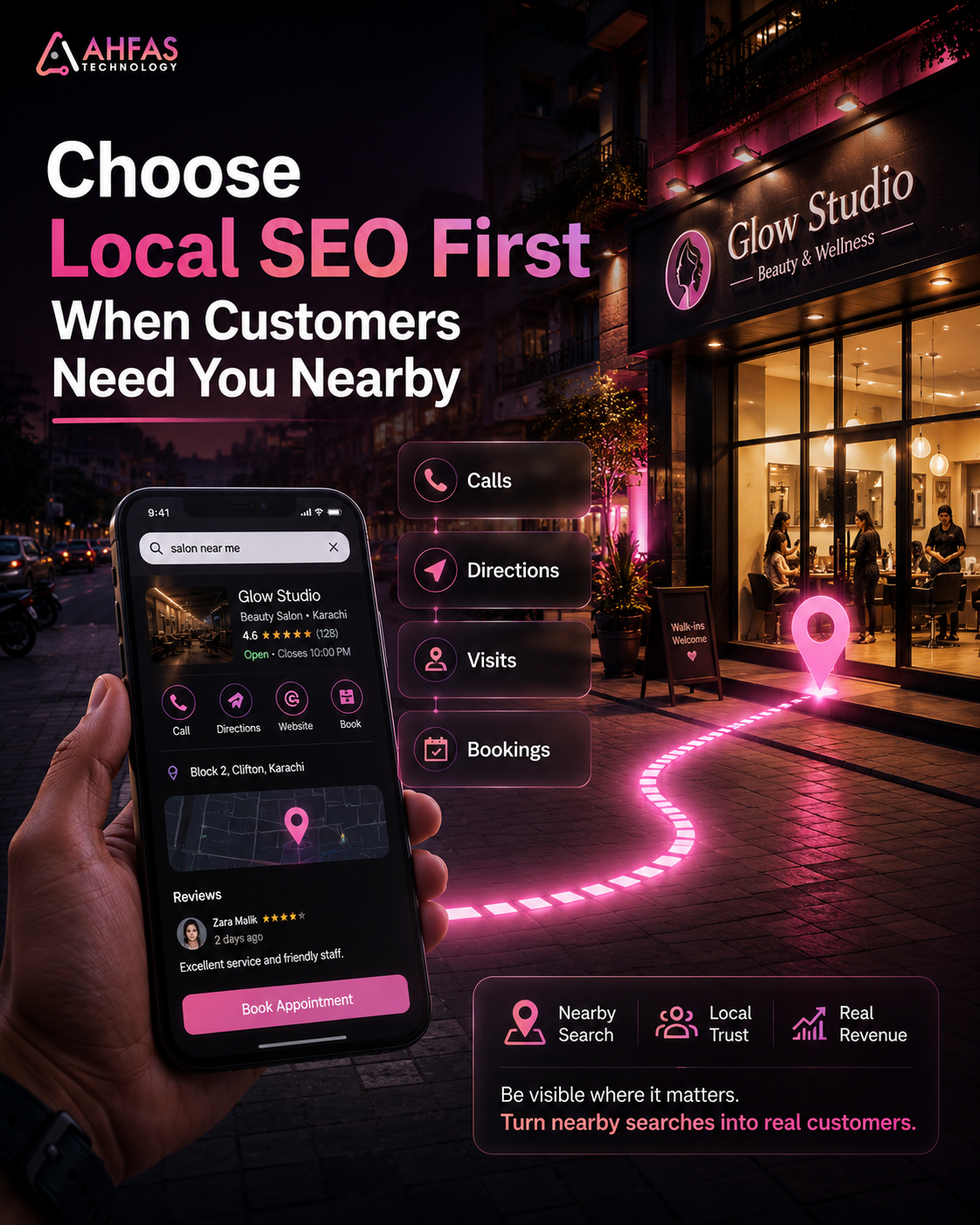
This usually applies to:
- Medical And Dental Clinics
- Restaurants And Cafes
- Salons And Spas
- Real Estate Offices
- Tuition Centres
- Repair Companies
- Electricians And Plumbers
- Retailers And Showrooms
- Legal And Accounting Practices
- Multi-Location Businesses
Consider a dental clinic in Gulshan-e-Iqbal.
Its immediate problem may not be national website traffic. It may be missing from Maps when nearby patients search for a dentist, or it may have incomplete hours, weak categories, few recent reviews, and no clear appointment button.
Its first priorities should include:
- Verifying And Completing The Business Profile
- Choosing Accurate Categories
- Adding Current Services, Hours, And Contact Details
- Earning Genuine Reviews
- Responding To Customer Feedback
- Fixing Inconsistent Business Information
- Improving Treatment And Location Pages
- Tracking Calls, Website Clicks, And Appointment Actions
Local SEO should come first because the shortest path to revenue starts with a nearby patient finding and trusting the clinic.
When Should Broader SEO Come First?
Choose broader SEO first when customers do not need to be physically close to the business.
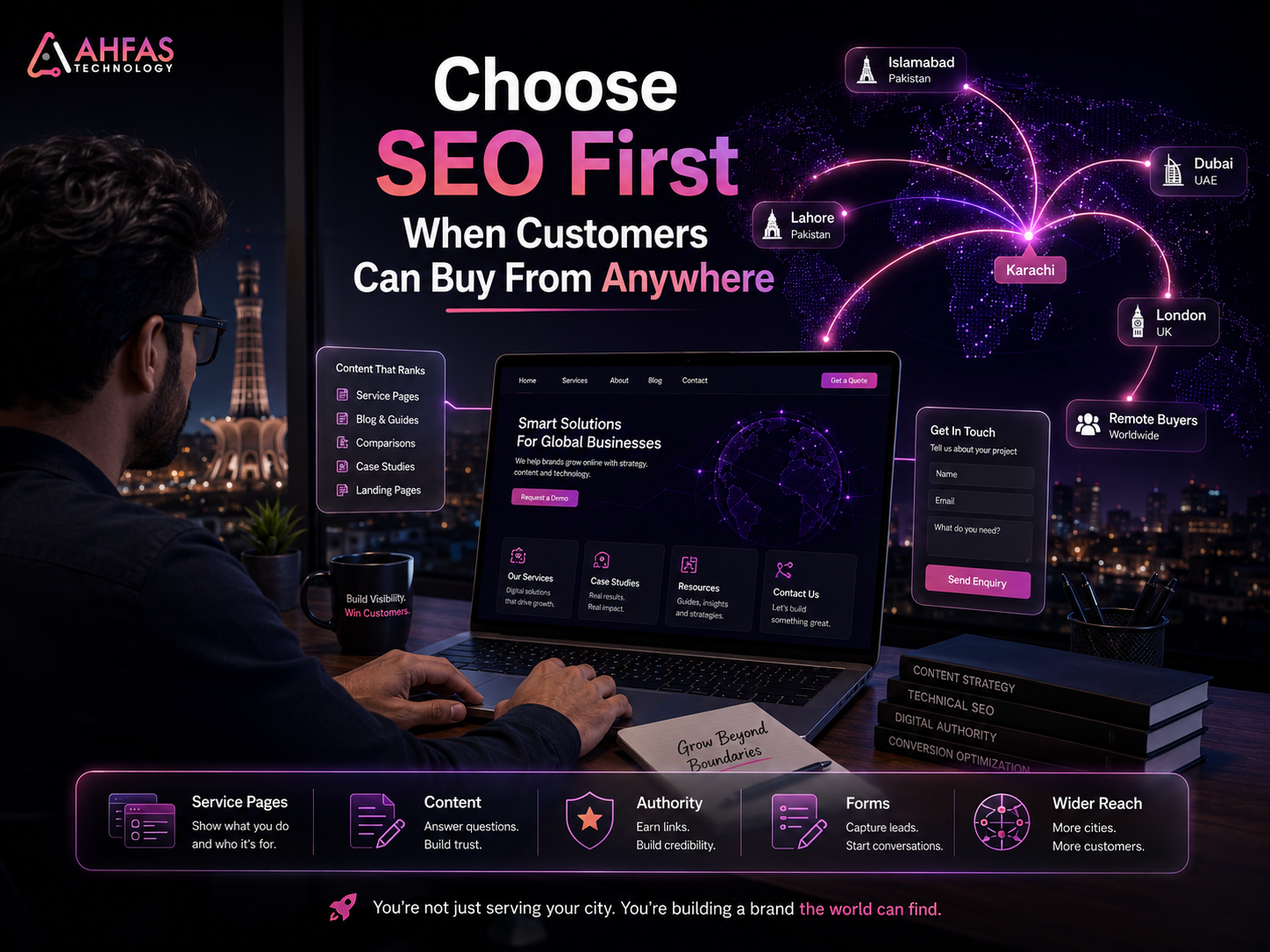
This often applies to:
- Software And It Companies
- Remote Consultants
- Nationwide Ecommerce Stores
- Export Businesses
- Online Education Platforms
- B2B service providers
- digital products
- agencies serving several cities or countries
A software company in Karachi may serve clients in Islamabad, Lahore, Dubai, London, or remotely anywhere. A strong Maps profile may support credibility, but it will not create enough demand on its own.
Its priorities may include:
- technical website fixes
- service-page keyword mapping
- industry-specific content
- comparison and decision-support articles
- internal linking
- backlinks and digital authority
- lead tracking
- stronger enquiry paths
In that case, professional SEO support should focus first on website visibility, relevance, and qualified non-local enquiries rather than neighbourhood searches.
When Does a Business Need Both?
Many Karachi businesses need both local and broader organic SEO.
A real estate firm may need Maps visibility for its office, local pages for developments, and informational content for buyers researching areas and investment options.
A clinic may need a strong Business Profile for appointments and detailed treatment pages for patients comparing procedures.
An ecommerce brand with a physical store may want Maps visibility for store visits while ranking product and category pages nationwide.
The correct model is phased, not divided blindly:
- Fix inaccurate or incomplete business information.
- Strengthen the highest-intent pages.
- Build local reputation and website authority together.
- Track which channel produces qualified actions.
- increase investment where real enquiries originate.
Quick Diagnosis Table
| Current Symptom | Likely Gap | What to Fix First |
| Business does not appear in Maps | Weak profile relevance or local signals | Profile, categories, services, reviews |
| Maps views but few calls | Weak trust or contact journey | Reviews, offer clarity, call and booking CTAs |
| Website ranks but local leads are low | Poor local relevance | Profile, local pages, location details |
| Profile performs but website is invisible | Weak organic foundation | Technical SEO, service pages, content |
| Traffic comes from irrelevant cities | Broad or unclear targeting | Keyword and page-intent mapping |
| Multiple locations compete internally | Duplicate location content | Unique pages and location architecture |
| Neither channel creates enquiries | Wider conversion problem | Offer, proof, tracking, UX, and CTAs |
What Most Karachi Businesses Get Wrong
They Treat Maps and Website SEO as Separate Campaigns
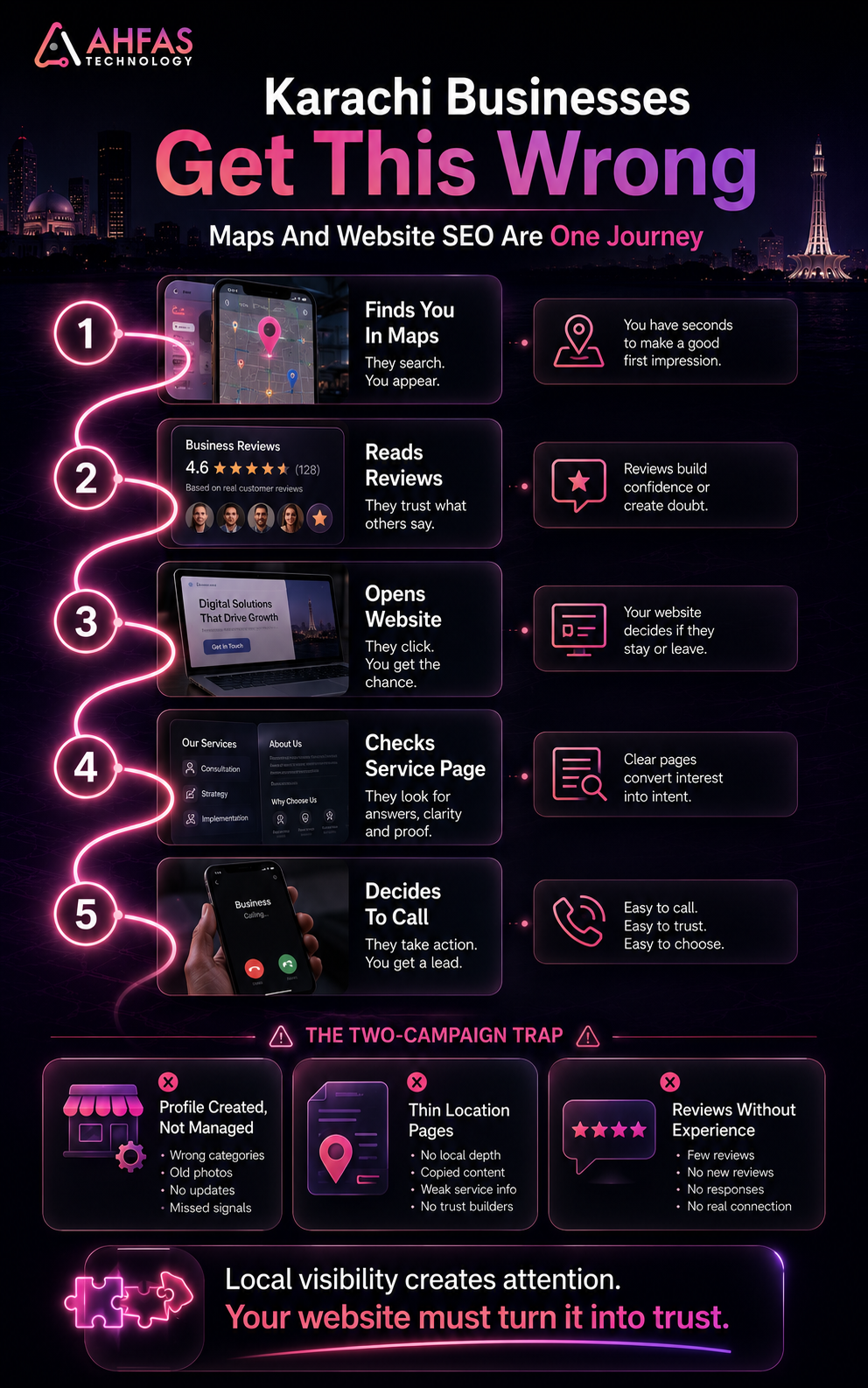
The customer does not see two campaigns.
They see one business.
Someone may find the company in Maps, read reviews, visit the website, inspect a service page, and then decide not to call because the page feels vague or outdated.
Local visibility creates attention. The website must convert that attention into confidence.
They Create a Business Profile and Stop
Claiming a profile is not the same as managing it.
Wrong categories, outdated hours, missing services, unanswered reviews, weak photos, and inconsistent contact details can all reduce clarity.
They Build Thin Location Pages
Copying one page and changing “Clifton” to “Gulshan” does not create useful local relevance.
Each location page should reflect real services, operating areas, customer needs, proof, contact options, and local context.
They Chase Reviews Instead of Improving Experience
Review generation should follow a genuine customer experience.
Buying fake reviews or pressuring people to leave only positive feedback damages trust and may violate platform policies.
They Expect Schema to Fix Rankings
LocalBusiness structured data can help Google understand information such as business hours, location, and departments. It does not guarantee a ranking or rich result.
Google recommends testing markup with the Rich Results Test and checking pages through URL Inspection after implementation.
What to Fix in the First 90 Days
Days 1 to 30: Diagnose the Search Journey
- Identify High-Value Local And Non-Local Queries
- Check Whether Maps Appears For Each Query
- Audit The Business Profile
- Audit Technical Seo And Indexability
- Review Service And Location Pages
- Check Reviews, Citations, And NAP Consistency
- Verify Call, Form, Booking, And Direction Tracking
Days 31 to 60: Repair the Weakest Foundation
For a local-first business:
- Correct Business Profile Information
- Improve Categories And Services
- Strengthen Local Pages
- Create A Legitimate Review Request Process
- Fix Inconsistent Business Details
For a broader-SEO-first business:
- Resolve Technical Issues
- Improve Service-Page Search Intent
- Consolidate Overlapping Pages
- Strengthen Internal Links
- Improve Calls To Action And Proof
Days 61 to 90: Expand What Works
Measure:
- Calls
- Direction requests
- Bookings
- Website clicks
- Form submissions
- Ranking queries
- Qualified enquiries
Do not scale based only on impressions or traffic. Scale the activity that moves potential customers closer to a real business outcome.
Local SEO vs SEO Checklist
Before investing, confirm:
- Does location limit who can buy?
- Does Google show Maps for the main queries?
- Is the Business Profile verified and complete?
- Are categories, hours, services, and contact details accurate?
- Does the website explain services and locations clearly?
- Are customer reviews genuine, recent, and answered?
- Are local pages useful rather than duplicated?
- Can Google crawl and index important pages?
- Are calls, forms, directions, and bookings tracked?
- Is each target keyword assigned to the right page?
- Does the campaign support the shortest path to revenue?
When to Get Professional Help
Professional guidance becomes useful when the website and Business Profile send conflicting signals, several locations need separate strategies, the business attracts visitors from the wrong areas, or the team cannot identify which channel produces qualified leads.
Sometimes the answer is not “more local SEO” or “more content.” The business may need better website pages, clearer proof, stronger tracking, or connected digital marketing services before additional search activity can perform.
AHFAS Technology can review local visibility, Google Business Profile health, organic rankings, website structure, target queries, and conversion tracking to identify the right first move.
Conclusion
The local SEO vs SEO decision should begin with the customer journey.
Choose local SEO first when nearby searches, Maps, calls, visits, and bookings drive revenue. Choose broader SEO first when the business serves customers remotely or across wider markets.
Use both when local visibility and long-term organic reach matter, but build them in the right order.
More tasks do not create a better strategy. Fixing the visibility gap closest to revenue does.
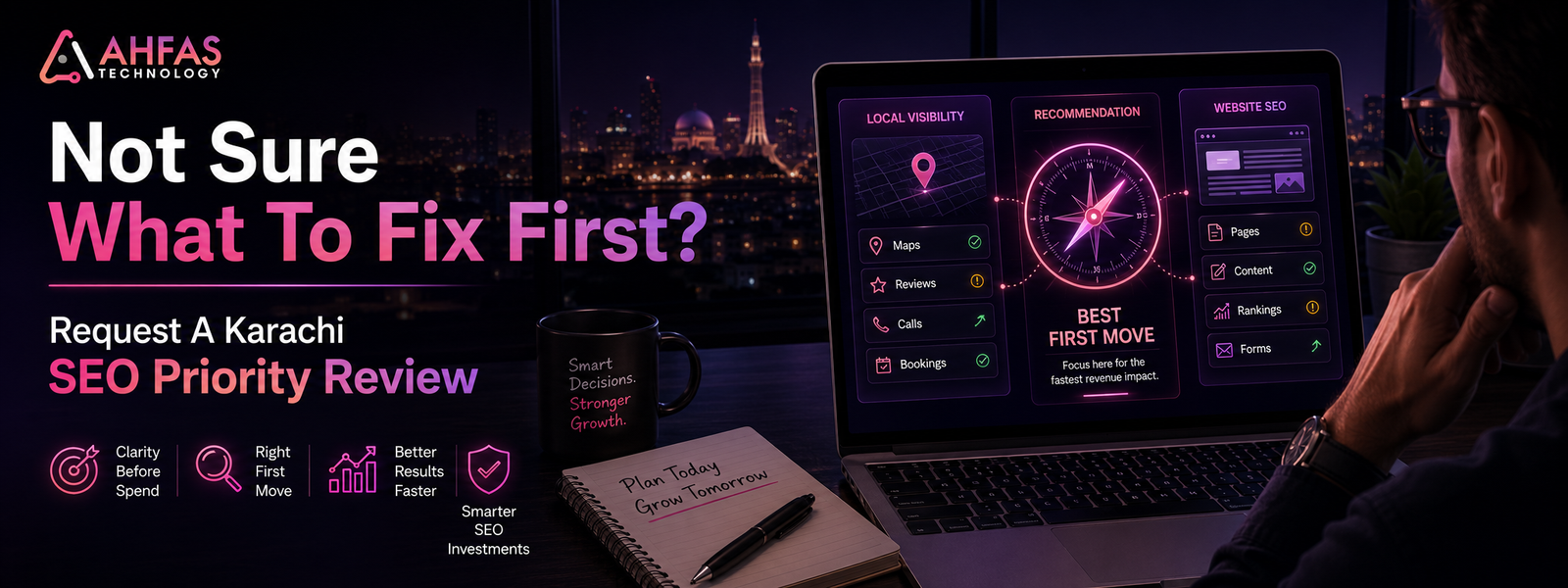
Before committing more budget to the wrong campaign, request a Karachi SEO priority review or email info@ahfastechnology.com.
FAQs
1. What Is the Difference Between Local SEO and SEO?
Local SEO targets nearby customers through Maps, the Local Pack, reviews, citations, and location pages. Broader SEO improves organic website visibility across wider geographic markets.
2. Is Google Business Profile Part of SEO?
Yes. Google Business Profile is a central local SEO asset because it manages how business information appears across Search and Maps. It works best alongside a trustworthy website.
3. Should a Karachi Business Choose Google Maps or Organic SEO First?
Choose Maps first when calls, directions, visits, or local bookings drive revenue. Choose organic SEO first when the business sells remotely or serves customers across multiple cities.
4. Does Location Affect Google Rankings?
Location strongly affects local results because distance is one of Google’s main local ranking factors. Businesses can improve relevance and prominence, but they cannot control every searcher’s proximity.
5. Do Google Reviews Improve Local Visibility?
Google says review count and positive ratings can contribute to local prominence. Reviews also help potential customers judge trust, but they must be genuine and policy-compliant.
6. Can Local SEO and Regular SEO Work Together?
Yes. Local SEO captures nearby intent, while broader SEO builds website authority and reach. Strong pages, links, technical health, reviews, and accurate business details can support the same customer journey.
7. What Should a Karachi SEO Priority Review Cover?
It should assess the Business Profile, Maps visibility, target queries, website pages, technical health, local signals, reviews, competitors, and conversion tracking before recommending a campaign.