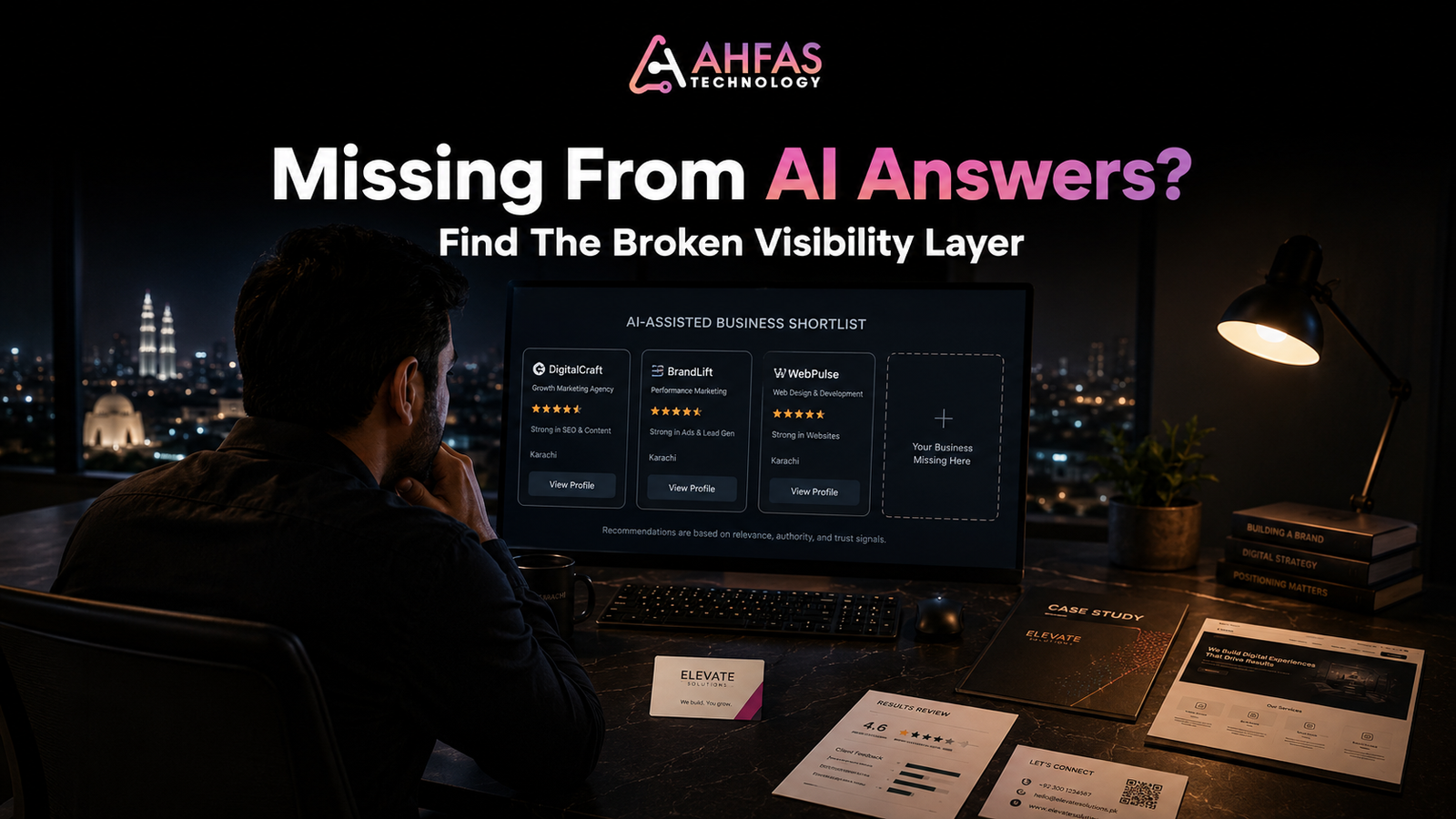
You ask ChatGPT to recommend businesses like yours.
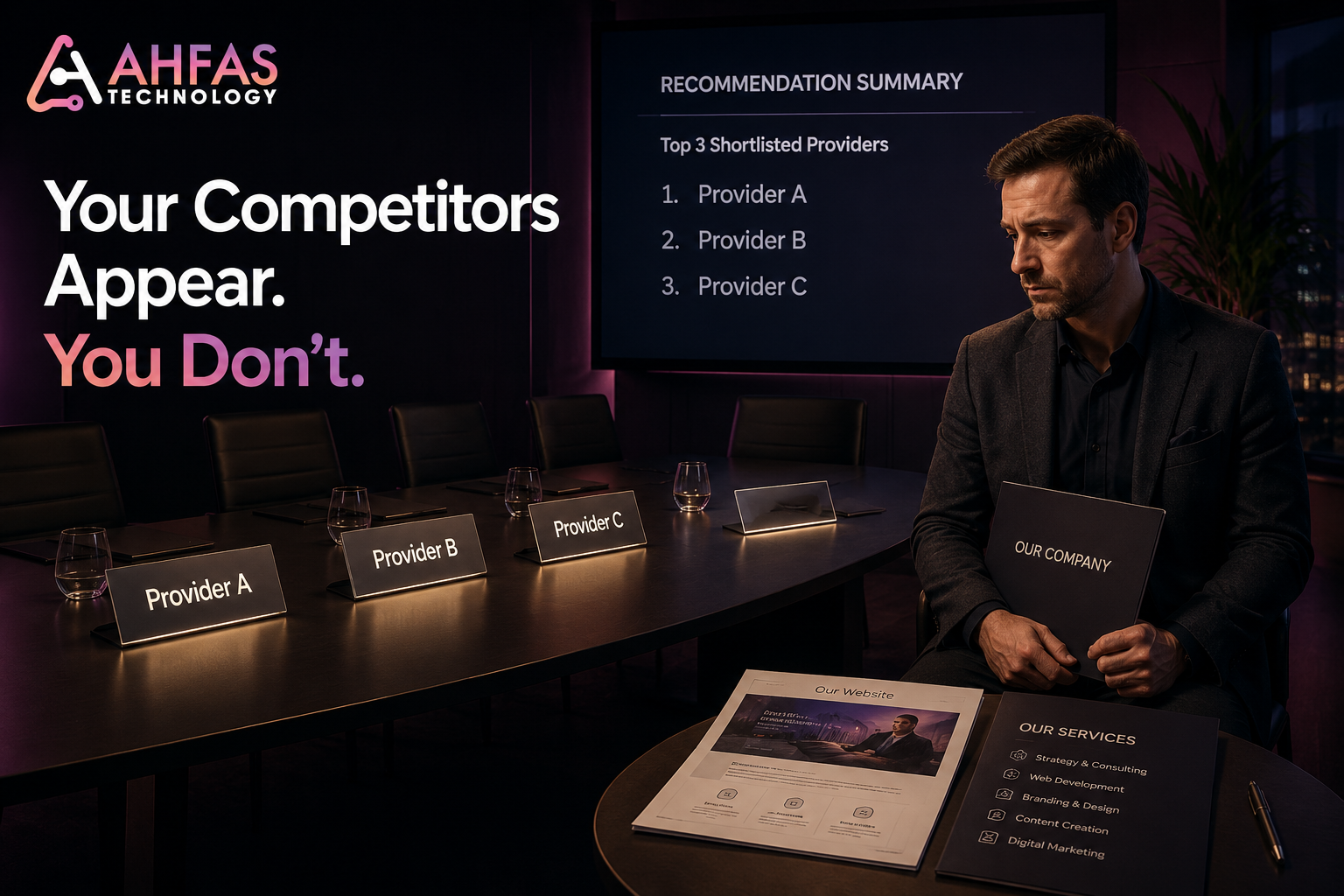
Your competitors appear. You do not.
A business not showing in ChatGPT is usually facing one or more of five problems: blocked access, weak discoverability, unclear business identity, generic content, or insufficient public evidence.
The solution is not to publish random articles, repeat more keywords, or add every new AI file someone recommends. You need to identify where the visibility path breaks, then fix that layer first.
This matters because AI platforms are starting to send measurable brand-discovery traffic. A May 2026 Similarweb analysis found that ChatGPT referrals increased 157.7% week over week after more prominent brand links appeared. Homepage referrals increased 354.7% during the same comparison period.
The opportunity is real, but no tag, schema type, crawler setting, or agency can guarantee that ChatGPT or Perplexity will recommend a business.
What you can do is make your company easier to access, understand, verify, and select.
Key Takeaways
- ChatGPT and Perplexity cannot reliably use pages they cannot access.
- Ranking on Google does not guarantee an AI mention or citation.
- Clear business identity matters more than repeating broad keywords.
- Generic service pages provide little useful information to extract.
- Credible reviews, profiles, references, and external mentions can reinforce your claims.
- AI visibility should be measured across multiple prompts and dates, not through one test.
What Does Showing Up in ChatGPT Actually Mean?
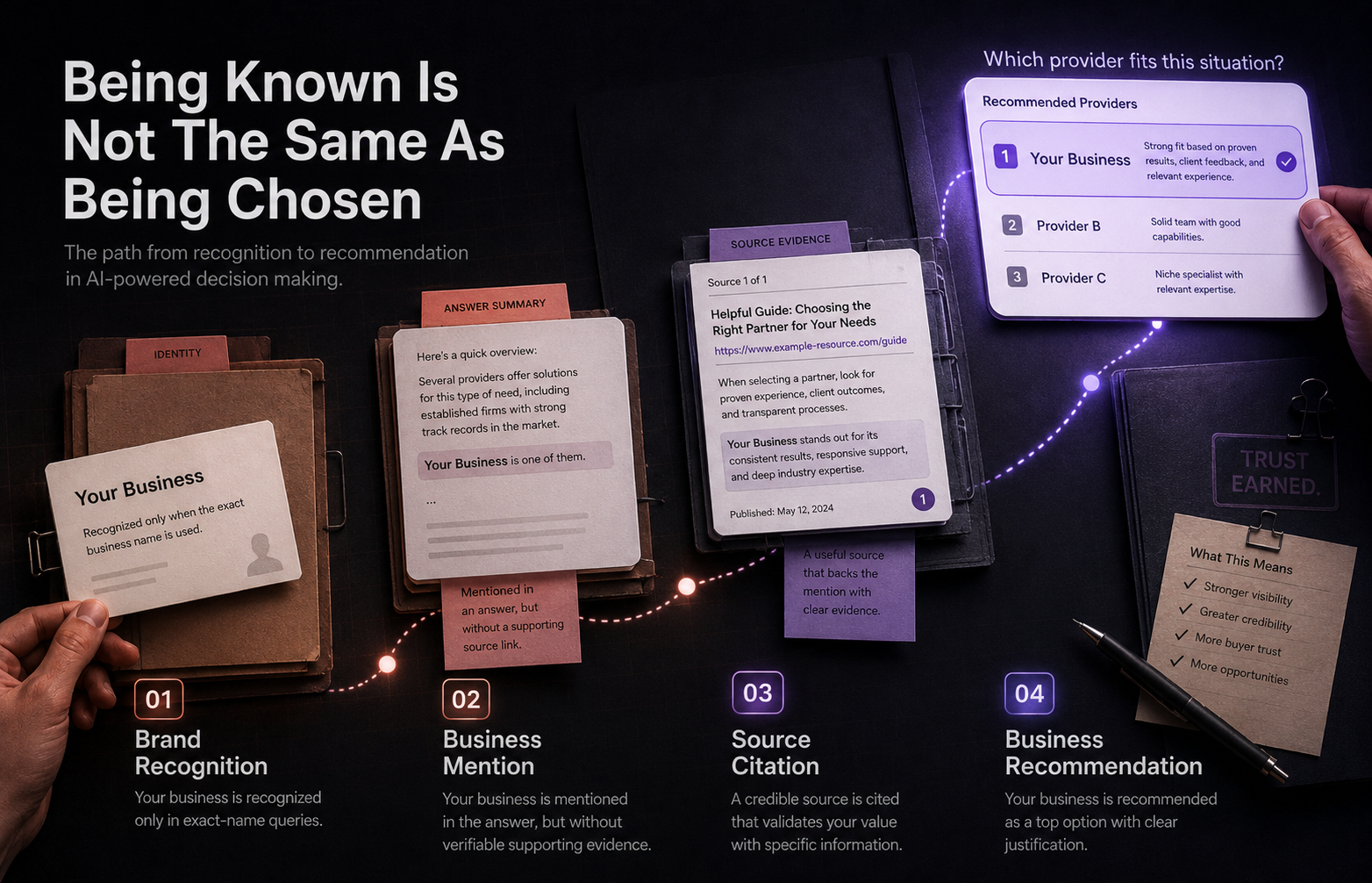
Showing up in ChatGPT or Perplexity can mean several different things.
Brand Recognition
The platform correctly identifies your company when someone searches your exact business name.
Business Mention
Your company is named inside an answer but does not receive a clickable source link.
Source Citation
Your website is linked as evidence supporting part of an AI-generated answer.
Business Recommendation
Your company is selected when someone asks for a provider, agency, clinic, consultant, product, or service.
These outcomes are not equal.
A business may be recognised by name but remain invisible for valuable unbranded searches such as:
- Who is a reliable SEO agency in Karachi?
- Which company can improve my visibility in ChatGPT?
- Who provides website development and SEO together?
- Which digital agency works with small businesses in Pakistan?
- Who can audit why my website is not ranking?
Your real goal is not simply to make ChatGPT recognise your name.
Your goal is to become a relevant and credible option when potential customers have not selected a business yet.
How Do ChatGPT and Perplexity Find Business Information?
ChatGPT Search retrieves current information from the public web and can include links to relevant sources.
OpenAI explains that ChatGPT may rewrite one user prompt into several targeted searches. You can review this process in the official ChatGPT Search documentation.
For example, a prompt such as:
Which digital marketing agency should a small Karachi business hire?
may require information about:
- Location
- Services
- Business Type
- Industry Experience
- Reviews
- Expertise
- Comparisons
- Proof
- Recent Content
- Contact Information
One homepage may not answer every part of that decision.
OpenAI states that public websites can appear in ChatGPT Search and recommends allowing OAI-SearchBot when publishers want their content to be discovered, cited, and linked. The current guidance is available in OpenAI’s Publishers and Developers FAQ.
Perplexity also crawls and retrieves public web information. Its official crawler documentation recommends allowing PerplexityBot and permitting requests from its published IP ranges.
Neither platform publishes a complete selection formula. Both may produce different answers based on query wording, available sources, freshness, location, and retrieval conditions.
The practical goal is to remove the reasons your business might be skipped.
The AHFAS Five-Layer AI Visibility Check
Use this framework before investing in more content.
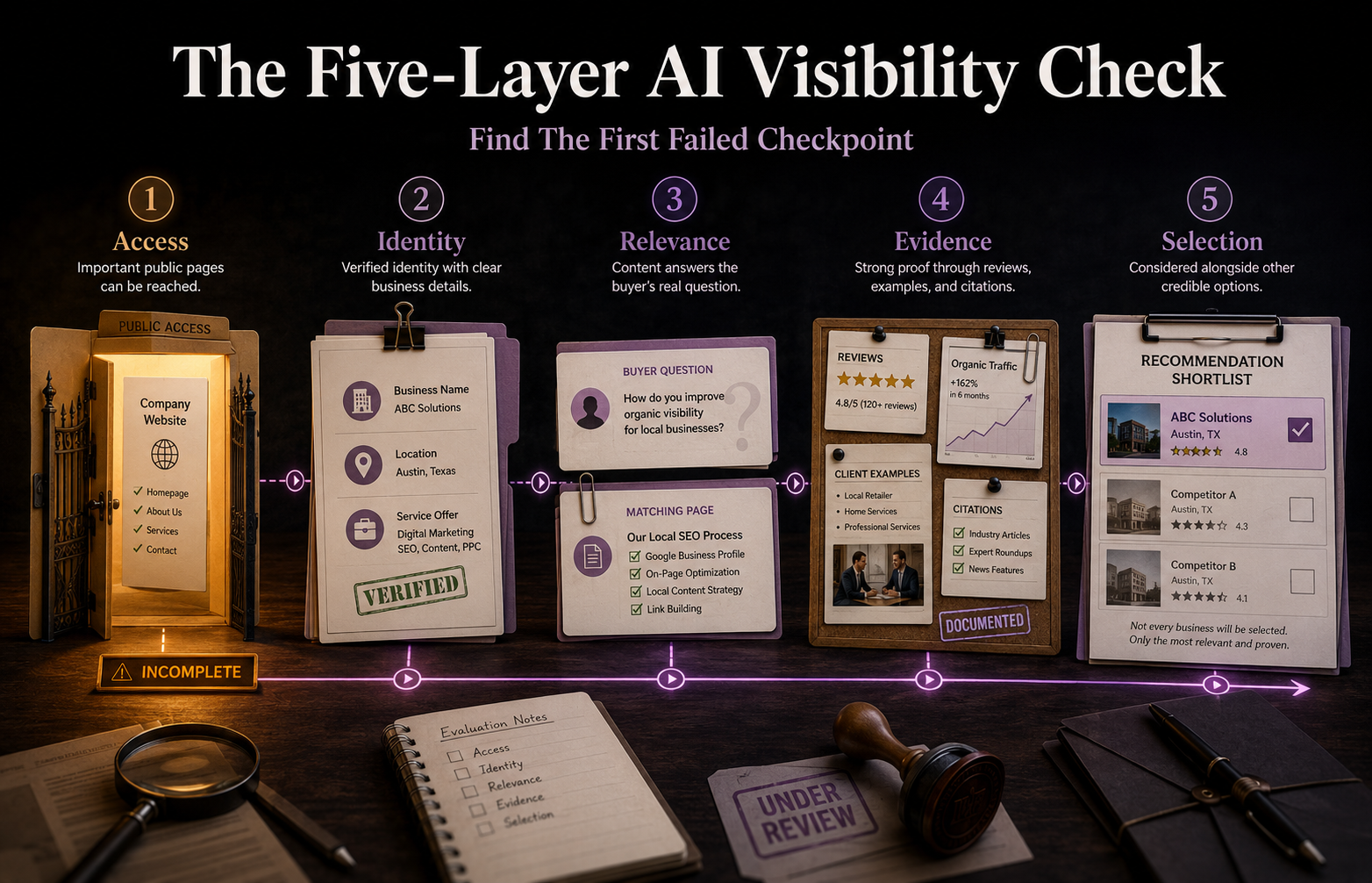
1. ACCESS
Can ChatGPT and Perplexity reach your important pages?
2. IDENTITY
Can they clearly understand who you are, where you operate, and what you offer?
3. RELEVANCE
Do your pages answer the questions potential customers are asking?
4. EVIDENCE
Can your claims be supported by public reviews, profiles, examples, references, and credible external mentions?
5. SELECTION
Is your business a suitable match for the location, service, audience, and situation described in the prompt?
A failure at an early layer weakens everything after it.
Publishing more content will not solve a blocked crawler. Schema will not rescue vague service pages. More directory listings will not fix conflicting contact information.
Start with the earliest broken layer.
AI Visibility Diagnosis Table
| What You Notice | Likely Problem | What to Check First | Priority |
| Your company appears only for its exact name | Weak unbranded relevance | Service pages and buyer questions | High |
| You appear in Perplexity but not ChatGPT | Platform-specific access or retrieval differences | OAI-SearchBot, indexing, prompt wording | High |
| Neither platform recognises your business | Access, identity, or evidence problem | Complete five-layer audit | Critical |
| AI describes your company incorrectly | Conflicting public information | Website, profiles, schema, directories | Critical |
| Your homepage appears but service pages do not | Weak internal links or thin service pages | Crawl paths and page quality | High |
| Your page ranks but receives no AI citations | Weak extractability, relevance, or evidence | Direct answers, sources, section clarity | Medium |
| Competitors appear in recommendation answers | Stronger relevance or public proof | Review their cited pages and profiles | High |
| Old services or contact details appear | Stale information across public sources | Update authoritative sources first | Critical |
Why Is Your Business Not Showing in ChatGPT?
1. ChatGPT or Perplexity Cannot Properly Access Your Website
Technical access is the first issue to investigate.
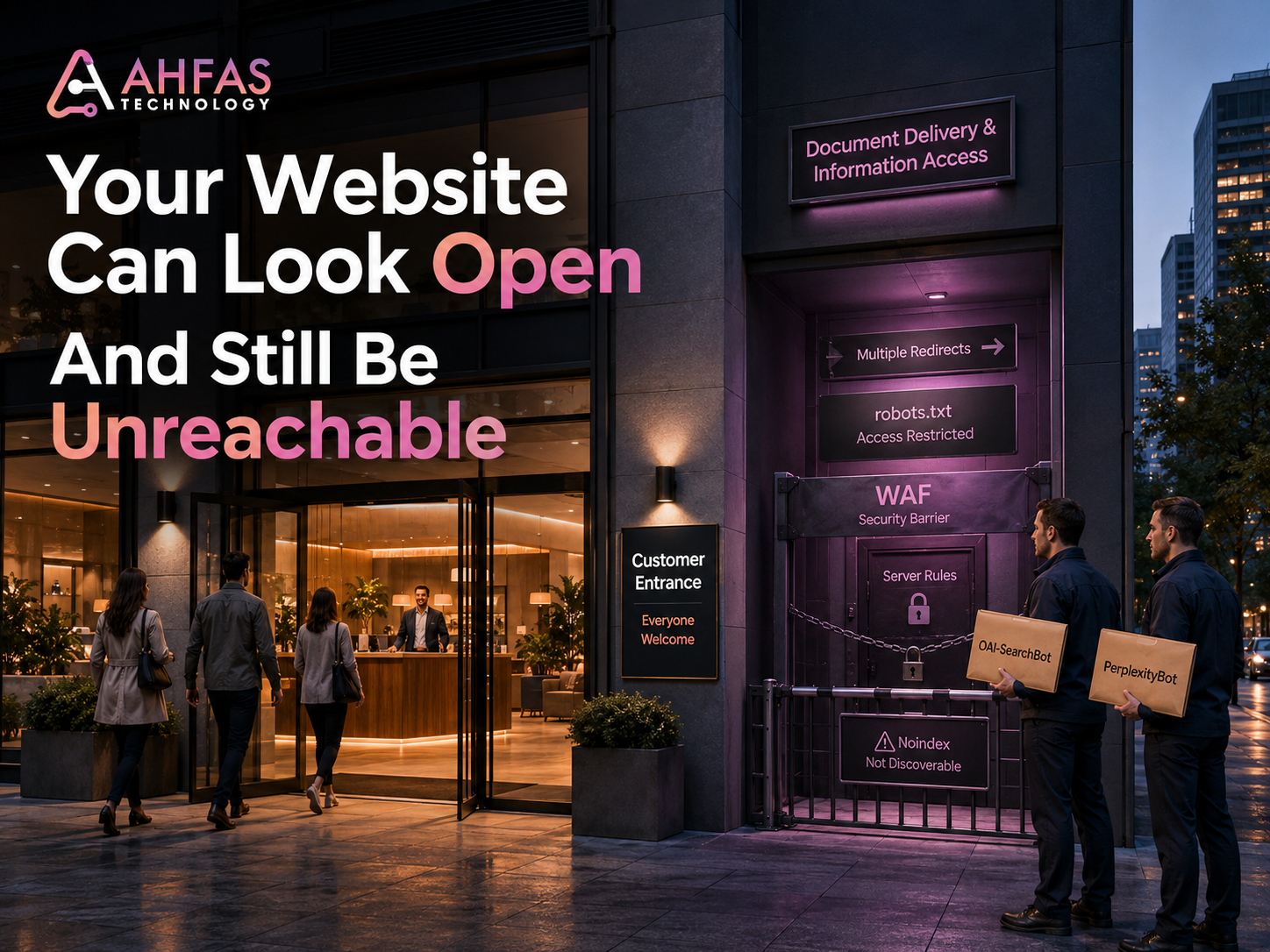
Your content may be visible to human visitors while still being restricted by:
- Robots.Txt Rules
- Firewall Settings
- CDN Security
- Bot-Protection Plugins
- Server Rules
- Repeated Crawl Errors
- Login Requirements
- Noindex Directives
- Javascript-Dependent Rendering
For ChatGPT Search discovery, review OAI-SearchBot, not only GPTBot.
OpenAI describes these user agents separately. OAI-SearchBot supports search discovery, while GPTBot relates to potential model training.
A basic robots.txt instruction may look like this:
User-agent: OAI-SearchBot
Allow: /
User-agent: PerplexityBot
Allow: /
Do not paste these rules blindly.
Your developer should also confirm that your hosting provider, CDN, and Web Application Firewall are not blocking the platforms’ official IP ranges. Robots.txt permission will not help when another security layer refuses the request.
What to Check First
- Review robots.txt.
- Inspect server and firewall logs.
- Confirm important URLs return a 200 status.
- Check for accidental noindex directives.
- Confirm your main content renders as accessible HTML.
- Test canonical URLs and redirect chains.
- Compare crawler settings with current official documentation.
Technical access can also be affected by how your website is developed. If key content, navigation, or calls to action are difficult for crawlers and users to process, review your custom website development foundation before adding more content.
2. Your Important Pages Are Difficult to Discover
Allowing access does not guarantee that every valuable page will be discovered or understood.
A page may remain practically invisible when it:
- Is Missing From The Xml Sitemap
- Has No Meaningful Internal Links
- Sits Too Many Clicks Away From The Homepage
- Uses An Incorrect Canonical Url
- Redirects Through Several Urls
- Duplicates Another Page
- Contains Very Little Useful Text
- Is Excluded From Search Indexes
- Receives Vague Anchor Text From Other Pages
Traditional search visibility still matters because ChatGPT Search can work with external search providers, and AI platforms often rely on indexed public information.
If Google and Bing struggle to discover or interpret a service page, AI retrieval systems may also receive weak signals about it.
This is similar to the difference between a website being indexed but not ranking. Discovery confirms that a page exists. It does not prove that the page is relevant, useful, trusted, or competitive enough to be selected.
What to Fix
- Add important URLs to the XML sitemap.
- Link to them from the homepage and services hub.
- Add contextual links from relevant articles.
- Use descriptive anchor text.
- Correct canonical and noindex settings.
- remove or consolidate duplicate pages.
- Keep important information in crawlable text.
- Update content when services or facts change.
Businesses with broader indexing, relevance, and internal-linking problems may need a proper SEO visibility audit before focusing specifically on AI citations.
3. Your Business Identity Is Unclear
An AI platform must understand that your business is one distinct entity before it can describe or recommend it confidently.
Confusion develops when public sources disagree about:
- Business Name
- Address
- Phone Number
- Email Address
- Website URL
- Services
- Office Locations
- Opening Hours
- Target Markets
- Founder Or Team Information
Mixed positioning can also weaken understanding.
One page may call the company a software house. Another calls it a creative studio. A third describes it as a marketing agency.
These descriptions may all be partly true, but the relationship between them must be clear.
A strong business identity should answer:
- What is the official company name?
- What does the company primarily do?
- Where is it based?
- Which markets does it serve?
- Which services are central?
- Who is responsible for the business?
- Which profiles officially belong to it?
Google explains that Organization structured data can help clarify administrative details such as an organisation’s name, URL, logo, contact information, address, and official profiles.
Structured data can support understanding. It does not guarantee an AI mention or recommendation.
What to Fix
- Use one official business name everywhere.
- Standardise phone numbers, emails, and addresses.
- Explain the relationship between multiple offices.
- Maintain a complete About page.
- Include visible team or leadership information.
- Connect verified profiles through accurate sameAs properties.
- Remove or correct outdated directory records.
- Keep service descriptions consistent across major profiles.
4. Your Service Pages Sound Like Every Other Business
Generic pages are easy to create and difficult to recommend.
Consider this statement:
We provide innovative digital solutions that help businesses grow.
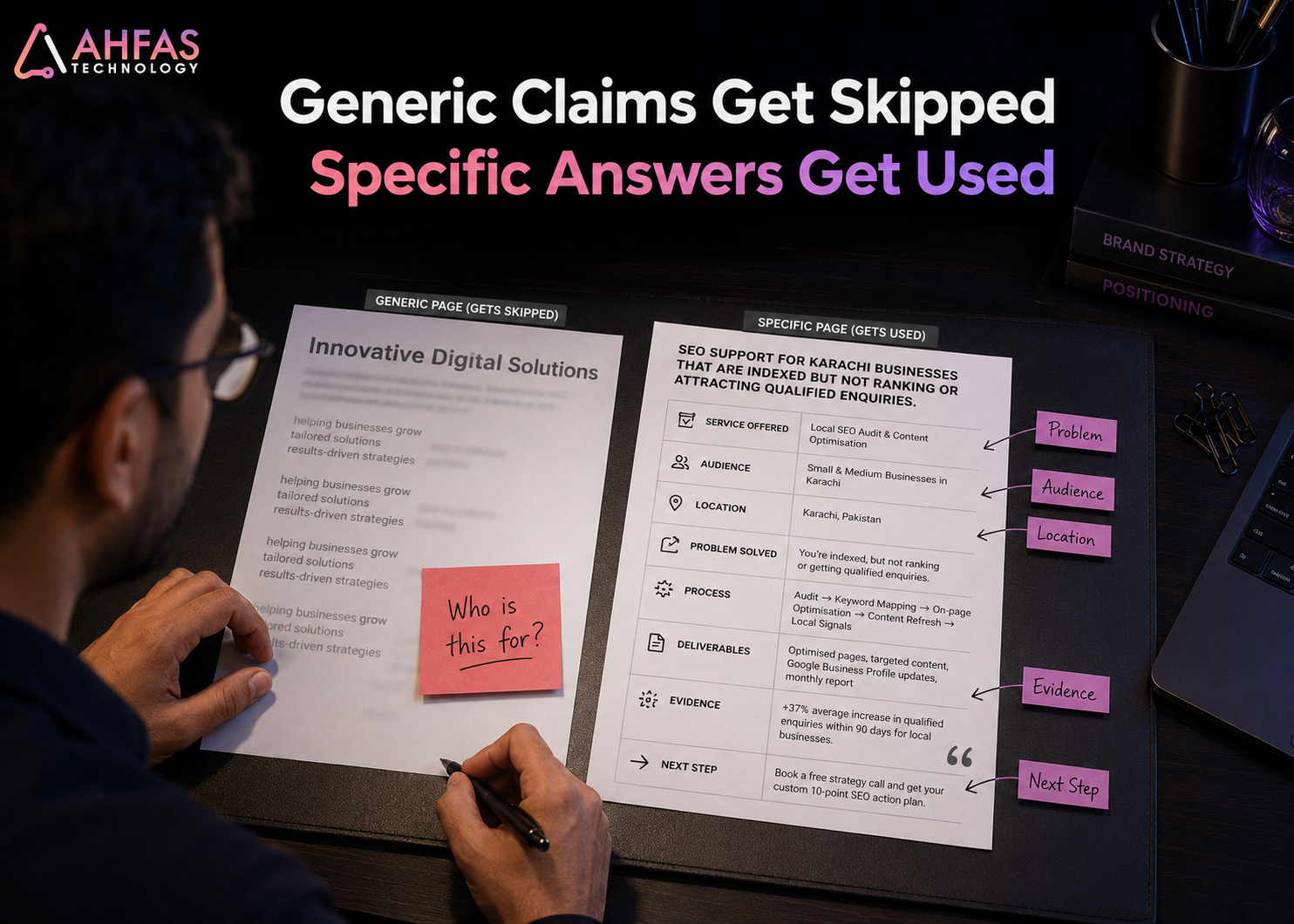
It could describe thousands of companies.
It does not explain:
- What The Company Actually Does
- Which Problems It Solves
- Who The Service Is For
- Where It Is Available
- What Is Included
- How The Process Works
- When The Service Is Suitable
- What Makes The Company Relevant
A more useful statement would be:
We provide SEO support for Karachi businesses that are indexed but not ranking, attracting irrelevant traffic, or losing enquiries because their service pages do not match buyer intent.
That sentence provides a service, audience, location, symptoms, and purpose.
Your service pages should make your expertise easy to understand without relying on vague claims such as “leading,” “trusted,” or “best.”
Improve Each Service Page
Explain:
- The problem the service solves
- The businesses it suits
- The location or market served
- The process
- The main deliverables
- The limitations
- The available proof
- The next step
Content also needs to sound distinct, specific, and useful. Thin or repetitive pages can be strengthened through search-intent-led content writing that answers real buyer questions instead of merely filling sections.
5. Your Content Does Not Match Recommendation Queries
Most companies optimise around service names.
Potential customers often ask decision-based questions instead.
They ask:
- Which provider fits my situation?
- How much should the service cost?
- What should be included?
- Which company should I trust?
- What warning signs should I avoid?
- Why is my current strategy failing?
- Should I hire an agency or freelancer?
- What should I fix before paying for marketing?
This is where query fan-out becomes important.
One broad prompt may trigger several supporting searches related to location, expertise, cost, comparisons, reviews, and service suitability.
Your content should cover the complete decision, not only define the service.
Content That Supports AI Discovery
Create useful content around:
- Pricing
- Comparisons
- Troubleshooting
- Checklists
- Proposal Evaluation
- Common Mistakes
- Service Suitability
- Local Considerations
- Implementation Steps
- Practical Limitations
- Measurable Outcomes
For example, an SEO agency should not publish only “What Is SEO?”
It should also answer:
- How much does SEO cost in Karachi?
- What should a monthly SEO package include?
- Why is my website indexed but not ranking?
- Should a small business choose SEO or Google Ads?
- How should two SEO proposals be compared?
- When should technical SEO come first?
These questions give the business more opportunities to become relevant during AI-assisted research.
6. Your Claims Exist Only on Your Own Website
A company calling itself experienced or trustworthy is publishing its own claim.
External evidence helps potential customers and AI systems evaluate that claim.
Useful public signals may include:
- Genuine Customer Reviews
- Accurate Directory Profiles
- Professional Association Listings
- Partner Pages
- Interviews
- Conference Participation
- Industry Contributions
- Reputable Media Coverage
- Verifiable Case Studies
- Client-Approved Portfolio Work
- Named Expert Profiles
This does not mean submitting the company to hundreds of low-quality directories.
Mass listings with copied descriptions and conflicting contact information can create more confusion.
Prioritise sources that are:
- Relevant
- Accurate
- Independently Maintained
- Publicly Accessible
- Consistent With Your Website
- Useful To Potential Buyers
Your own website should also include evidence such as:
- Named Authors And Reviewers
- Genuine Work Examples
- Clear Processes
- Approved Case Studies
- Source Links For Factual Claims
- Visible Contact Information
- Publication And Update Dates
- Honest Limitations
Never invent clients, reviews, awards, certifications, or performance results.
7. Competitors Are Easier to Understand and Verify
Sometimes nothing is technically broken.
A competitor simply provides a clearer and better-supported answer.
They may have:
- Stronger Positioning
- More Complete Service Pages
- Fresher Content
- Better Reviews
- More Useful Comparisons
- Stronger Local Information
- Credible External Mentions
- Clearer Authorship
- Better Case Studies
- More Consistent Business Information
AI visibility is comparative.
Your page does not need to be poor to lose selection. It only needs to be less relevant or useful for the specific question than the available alternatives.
Review the exact pages and sources cited in competitor answers.
Ask:
- Which question does this page answer?
- Why is the information easy to extract?
- What proof is included?
- Which service or location details are clear?
- What part of the buyer journey is covered?
- What does this page explain that ours does not?
Do not copy the competitor.
Close the information gap with clearer reasoning, stronger evidence, and more practical value.
Real-World Case Study: When ChatGPT Made Brands More Clickable
In May 2026, ChatGPT began displaying more prominent clickable brand links in answers.
Similarweb analysed desktop clickstream activity before and after the change.
Its ChatGPT referral traffic analysis reported that:
- Total ChatGPT referrals increased 157.7% week over week
- Homepage referrals increased 354.7%
- The share of referrals landing on homepages rose to around 60%
- Traffic remained above its earlier baseline during the measured period
What Businesses Can Learn
AI discovery does not send users only to blog posts.
It can introduce people directly to a business.
That makes your homepage, service descriptions, identity signals, and conversion path important. A visitor arriving from ChatGPT may already understand the problem. They now need to confirm:
- Who You Are
- What You Offer
- Where You Work
- Why You Are Credible
- What They Should Do Next
AI visibility without a clear and trustworthy landing page can still waste the opportunity.
How to Test Your AI Visibility in 30 Minutes
Do not test only your business name.
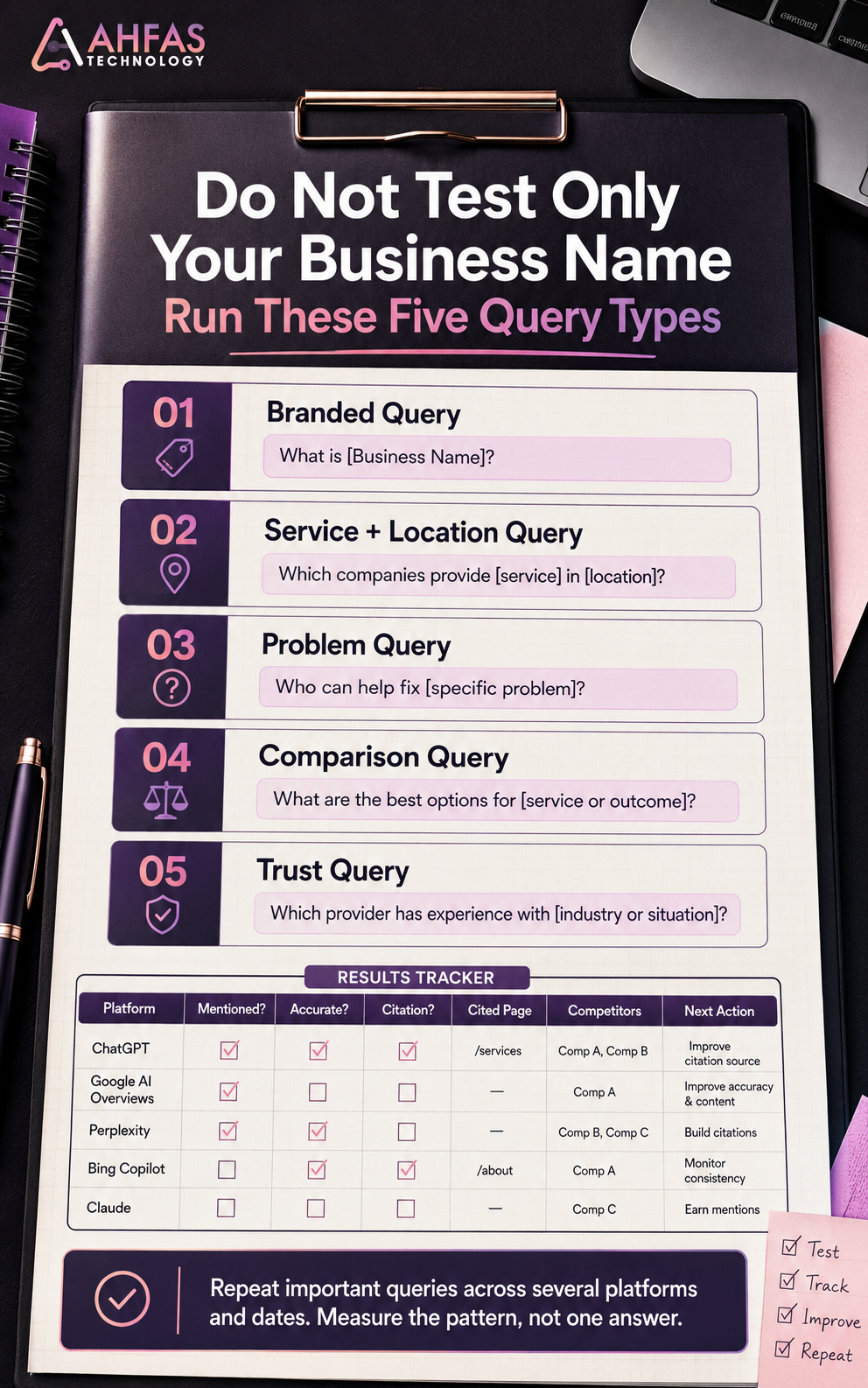
That measures branded recognition, not recommendation visibility.
Step 1: Create Five Query Types
Branded Query
What is [Business Name]?
Service and Location Query
Which companies provide [service] in [location]?
Problem Query
Who can help fix [specific problem]?
Comparison Query
What are the best options for [service or outcome]?
Trust Query
Which provider has experience with [industry or situation]?
Step 2: Test Several Platforms
Run the same questions in:
- Chatgpt With Web Search
- Perplexity
- Microsoft Copilot
- Google Ai Features Where Available
Record:
- Whether Your Company Appears
- Whether The Description Is Accurate
- Which Competitors Appear
- Which Pages Receive Citations
- Which External Sources Are Used
- Which Services Or Locations Are Missing
Step 3: Repeat the Tests
AI-generated answers can vary by prompt wording, timing, location, and source availability.
A 2026 study on generative search visibility found that citation results varied across repeated searches. A single test can therefore create a misleading impression of visibility.
Repeat important queries and evaluate the pattern.
Step 4: Review Technical Access
Check:
- Robots.txt
- OAI-Searchbot
- Perplexitybot
- Firewall Logs
- Cdn Settings
- Response Codes
- Noindex Directives
- Canonical URLS
- Rendered HTML
- XML Sitemap Inclusion
Step 5: Review Search Discoverability
Use:
- Google Search Console
- Bing Webmaster Tools
- Url Inspection
- Sitemap Reports
- Indexed-Page Checks
- Internal-Link Analysis
Step 6: Review Business Consistency
Compare information across:
- Your Website
- Google Business Profile
- Bing Places
- Review Platforms
- Business Directories
- Partner Listings
- Structured Data
Step 7: Review Cited Competitor Pages
Open the exact pages cited by ChatGPT and Perplexity.
Compare:
- Answer Clarity
- Service Relevance
- Evidence
- Freshness
- Authorship
- External Sources
- Examples
- Structure
- Local Context
What Should You Fix First?
Follow this order to avoid wasting time and budget.
Priority 1: Access
Fix blocked crawlers, firewall restrictions, server errors, broken pages, and accidental noindex directives.
Priority 2: Discoverability
Improve indexing, internal links, sitemap accuracy, canonical URLs, and page depth.
Priority 3: Identity
Standardise the business name, services, locations, contact details, profiles, and structured data.
Priority 4: Service Clarity
Improve thin pages with clearer audiences, problems, processes, deliverables, evidence, and next steps.
Priority 5: Query Coverage
Publish content that answers pricing, comparison, troubleshooting, and hiring questions connected to your services.
Priority 6: Public Evidence
Improve genuine reviews, relevant profiles, approved case studies, citations, partnerships, and expert contributions.
Priority 7: Measurement
Track citations, referrals, landing pages, queries, and assisted leads. Use the results to improve the pages that matter.
How Can You Measure ChatGPT and Perplexity Visibility?
Track ChatGPT Referral Traffic
OpenAI states that referral links from ChatGPT Search include:
utm_source=chatgpt.com
Review this source in your analytics platform and measure:
- landing pages
- engagement
- form submissions
- calls or messages
- assisted conversions
- geographic location
- lead quality
OpenAI provides the tracking detail in its Publishers and Developers FAQ.
Use Bing AI Performance
Bing introduced AI Performance reporting in Webmaster Tools in February 2026.
The report can show:
- total citations
- average cited pages
- page-level citation activity
- citation trends
- sample grounding queries
Bing notes that citations do not represent rankings or page authority. They indicate when supported AI experiences referenced a website.
Read the official Bing AI Performance announcement.
Maintain a Manual Query Tracker
Create a simple sheet with:
| Query | Platform | Date | Business Mentioned | Citation | Cited URL | Competitors | Accuracy | Next Action |
Run the same query set regularly rather than reacting to one isolated answer.
What Should Karachi and Pakistan-Based Businesses Clarify?
Businesses serving local and international markets often leave important information unstated.
Clearly explain:
- Primary Office Location
- Additional Offices
- Service Areas
- Remote Service Availability
- Official Contact Numbers
- Working Hours
- Main Service Categories
- Target Industries
- Language Support
- International Service Coverage
A Karachi-based company serving UK or global clients should explain that relationship directly.
Do not expect an AI platform to infer it from separate address blocks.
Location pages should also provide real value. Replacing city names across copied pages does not establish meaningful local relevance.
Common Mistakes That Waste Time
Publishing More Generic Content
More articles will not fix blocked crawlers, inconsistent identity, or weak service pages.
Treating Schema as a Visibility Switch
Schema supports understanding. It cannot force an AI citation or recommendation.
Confusing GPTBot With OAI-SearchBot
Review search-discovery and model-training controls separately.
Treating llms.txt as the Main Solution
An llms.txt file may help systems that choose to use it, but it is not a universal submission system or guaranteed ranking factor.
Prioritise crawlability, indexing, business clarity, relevant content, evidence, and internal links first.
Buying Mass Listings or Fake Reviews
Low-quality citations and manufactured reviews can weaken trust and create conflicting information.
Testing One Prompt Once
AI outputs vary. Measure patterns across multiple queries, platforms, and dates.
Chasing Mentions Without Fixing Conversions
A citation has limited business value when the landing page does not explain the service, build confidence, or make contact easy.
AI Visibility Checklist
Technical Access
- OAI-SearchBot can access important public pages
- PerplexityBot is not blocked
- Your WAF accepts legitimate crawler requests
- Important pages return a 200 response
- No accidental noindex directives exist
- Canonical tags point to the correct URLs
- The XML sitemap is current
- Core content appears in rendered HTML
Entity Clarity
- The business name is consistent
- Phone, email, and address details match
- Office relationships are clearly explained
- Core services are defined consistently
- Organization schema is accurate
- Official profiles are connected
- About and Contact pages contain complete information
Content Relevance
- Every primary service has a dedicated page
- Service pages answer buyer questions
- Important pages provide direct answers
- Pricing and comparison queries are covered
- Troubleshooting pages explain causes and fixes
- Content includes specific examples
- Thin and duplicate pages have been improved
Trust and Evidence
- Reviews are genuine
- Authors and reviewers are visible
- Case studies are verifiable
- Important claims have credible sources
- Contact information is easy to confirm
- Time-sensitive pages show update dates
- External profiles reinforce the same business identity
Measurement
- ChatGPT referral traffic is tracked
- Bing Webmaster Tools is configured
- AI citations are monitored
- A consistent test-query set exists
- Competitor citations are reviewed
- AI-assisted enquiries are recorded
When Should You Get Professional Help?
Professional support may be useful when:
- AI crawlers Are Blocked By Complex Hosting Or Firewall Settings
- Several Versions Of Your Business Information Exist
- Your Website Ranks But Receives Little Ai Visibility
- Important Service Pages Remain Undiscovered
- Competitors Dominate Traditional And Ai Search
- You Do Not Know Which Page Should Target Each Query
- Your Content Receives Impressions But Few Enquiries
- Indexing And Canonical Problems Keep Returning
A proper audit should review more than one ChatGPT prompt.
It should examine:
- Crawler Access
- Indexing
- Site Structure
- Entity Consistency
- Service-Page Clarity
- Content Gaps
- Public Sources
- Citations
- Buyer Queries
- Analytics
- Conversion Paths
Final Thoughts
When your business is not showing in ChatGPT, do not respond by publishing random content or adding more keywords.
Check access, discoverability, identity, relevance, evidence, and selection in that order. Fix the earliest broken layer first.
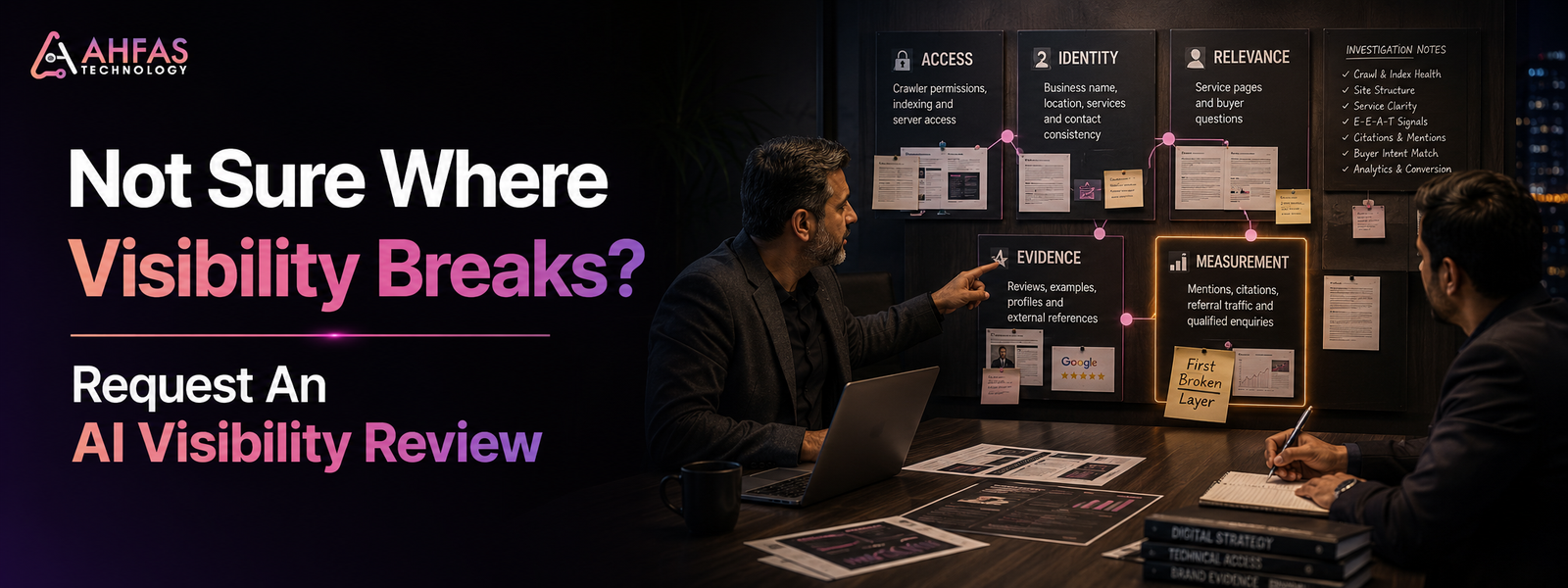
Not sure where your visibility breaks? Request an AI visibility review and find out what needs attention before investing in more content.
Frequently Asked Questions
Why is my business not showing in ChatGPT?
Your website may be blocked, poorly indexed, unclear about its services, inconsistent across public profiles, or weakly supported by credible evidence. Start with crawler access, indexing, business identity, service-page quality, and buyer-query coverage.
How do I get my business to appear in ChatGPT results?
Allow OAI-SearchBot, keep important pages indexable, explain services clearly, maintain consistent business information, answer decision-stage questions, and build genuine public proof. These actions improve eligibility and relevance but cannot guarantee inclusion.
Does ranking on Google guarantee a ChatGPT recommendation?
No. Traditional rankings can support discovery, but ChatGPT forms its answer around the specific prompt and available sources. A ranking page may still be less useful, current, or verifiable than another source.
Should I allow GPTBot or OAI-SearchBot?
Allow OAI-SearchBot when you want public content considered for ChatGPT Search. GPTBot relates to potential model-training use and can be managed separately. Check OpenAI’s latest documentation before changing crawler rules.
Why does my business appear in Perplexity but not ChatGPT?
The platforms use different crawlers, retrieval systems, search partners, and query interpretations. Compare crawler access, indexing, cited sources, business information, page relevance, and prompt wording.
Does schema markup help a business appear in AI answers?
Accurate Organization or LocalBusiness schema can clarify your name, address, website, contact details, logo, and official profiles. It supports machine understanding but does not guarantee an AI citation.
How long does AI visibility improvement take?
There is no fixed timeline. Technical changes may be recognised sooner, while indexing, authority, reviews, content improvement, and external evidence may require more time. Measure visibility over several weeks and repeated query tests.
Can I track visitors from ChatGPT?
Yes. ChatGPT Search referral links include utm_source=chatgpt.com. Track landing pages, engagement, form submissions, assisted conversions, and lead quality instead of counting visits alone.
Do I need an llms.txt file?
An llms.txt file is optional and is not a guaranteed ChatGPT or Perplexity visibility requirement. Prioritise crawler access, indexing, business clarity, useful content, credible evidence, and accurate structured data first.
Can an agency guarantee that ChatGPT will recommend my business?
No ethical provider can guarantee a recommendation. AI results vary by platform, prompt, location, timing, available sources, and system changes. An agency can remove barriers, improve relevance, strengthen evidence, and measure progress.