
Three agencies send you three SEO proposals.
One promises 100 backlinks. Another offers 20 keywords and four monthly blogs. The third costs twice as much but lists fewer deliverables.
Which package is actually worth signing?
The right SEO packages Karachi businesses should consider are not necessarily the cheapest, longest, or most impressive-looking proposals. A reliable package should diagnose your website, prioritise the work affecting visibility and enquiries, define who will implement every change, and measure progress against meaningful business goals.
Before signing a monthly contract, compare the strategy behind the package, not just the number of keywords, blogs, backlinks, or reports listed inside it.

Key Takeaways
- Compare the diagnosis and proposed strategy before comparing prices.
- Confirm whether the agency implements fixes or only recommends them.
- Treat guaranteed rankings and bulk backlink promises as serious warnings.
- Connect keywords to relevant pages, search intent, and business value.
- Track qualified traffic, calls, forms, sales, and enquiries, not rankings alone.
- Keep ownership of your website, content, analytics, Search Console, and business profiles.
- Request a written 30, 60, and 90-day plan before signing.
Why Are SEO Packages in Karachi So Difficult to Compare?
SEO agencies rarely describe their services in the same way.
One agency may sell a fixed number of keywords. Another may focus on blogs and backlinks. A third may include technical SEO, content strategy, local search, conversion tracking, development support, and ongoing optimisation under one monthly retainer.
The price difference can be equally confusing.
A Current Karachi SEO Pricing Snapshot
Publicly listed packages reviewed in July 2026 included:
- packages starting at PKR 15,000 per month
- Karachi packages between PKR 39,999 and PKR 94,999 per month
- packages between PKR 80,000 and PKR 150,000 per month
- USD-priced plans between $199 and $599 per month
These public prices can change, and they do not represent a verified market average. AHFAS does not endorse or evaluate these providers through this article.
The range proves one important point:
Price alone cannot tell you whether an SEO package is complete, safe, commercially useful, or suitable for your website.
A PKR 25,000 package may be appropriate for a small website with limited competition and a narrow objective. A PKR 150,000 package can still waste money if it produces monthly activity without solving the website’s real problems.
The better question is:
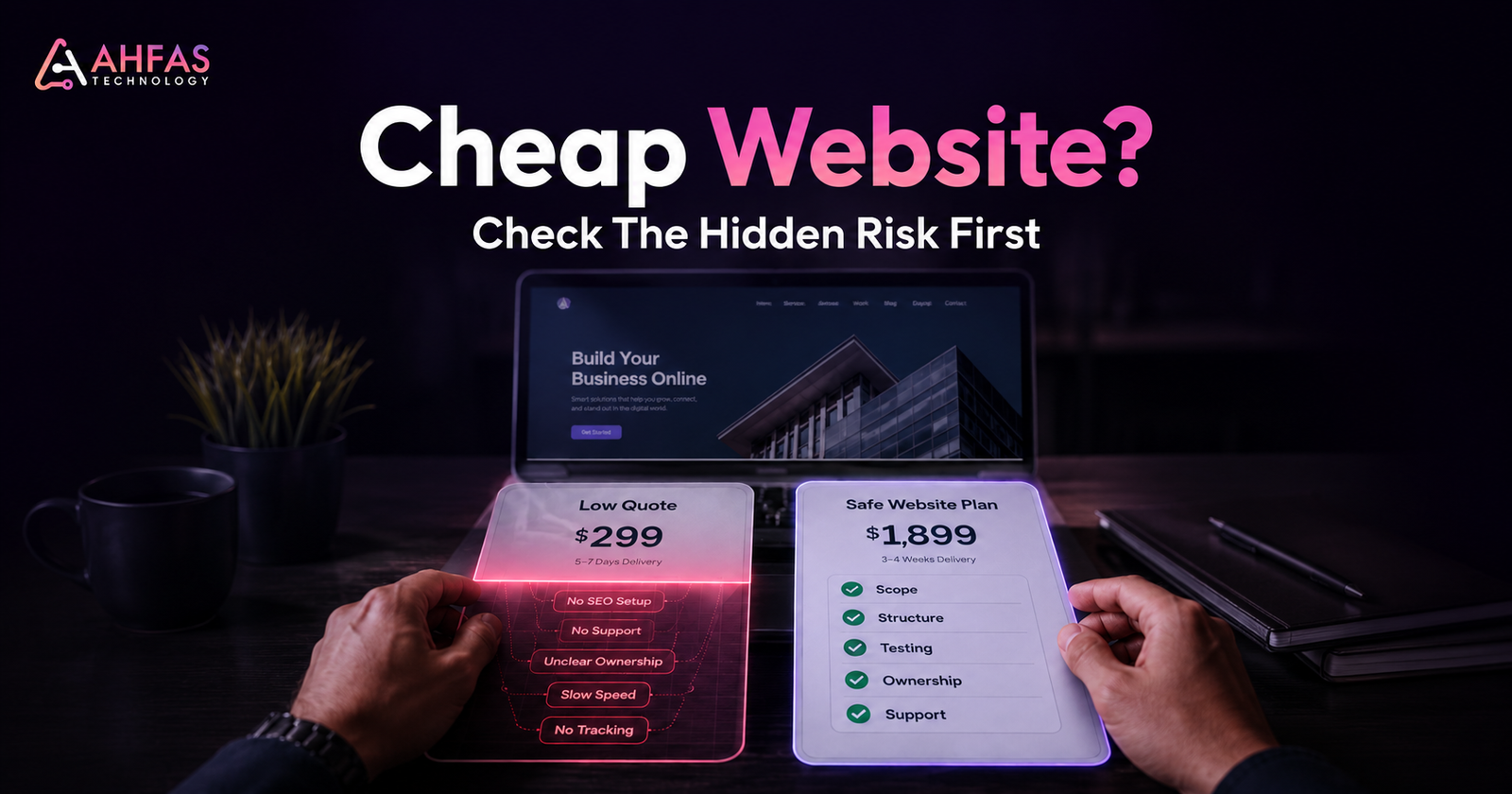
What will this package diagnose, implement, improve, and measure for my business?
What Should an SEO Package Actually Include?
An SEO package is a defined combination of research, technical work, page optimisation, content, authority building, reporting, and support delivered for a recurring or fixed fee.
A useful package should clearly explain:
- which business problem it aims to solve
- which services, products, or locations it will prioritise
- which pages will be improved
- what work the agency will complete
- what work the client must handle
- how success will be measured
- what the monthly fee excludes
- how priorities may change after the audit
A weak package lists activities without connecting them to your website, market, customers, or business goals.
For example:
20 keywords, 50 backlinks, four blogs, monthly reporting
That list sounds measurable, but it leaves critical questions unanswered:
- Are the keywords commercially relevant?
- Which pages will target them?
- Does the website already have suitable pages?
- Who will implement technical fixes?
- How will the backlinks be acquired?
- Who researches and reviews the articles?
- Will calls, forms, sales, and WhatsApp enquiries be tracked?
- What happens if the original strategy proves wrong?
A package does not become a strategy simply because it contains many line items.
Compare the SEO Package Model First
Most proposals follow one of three models.
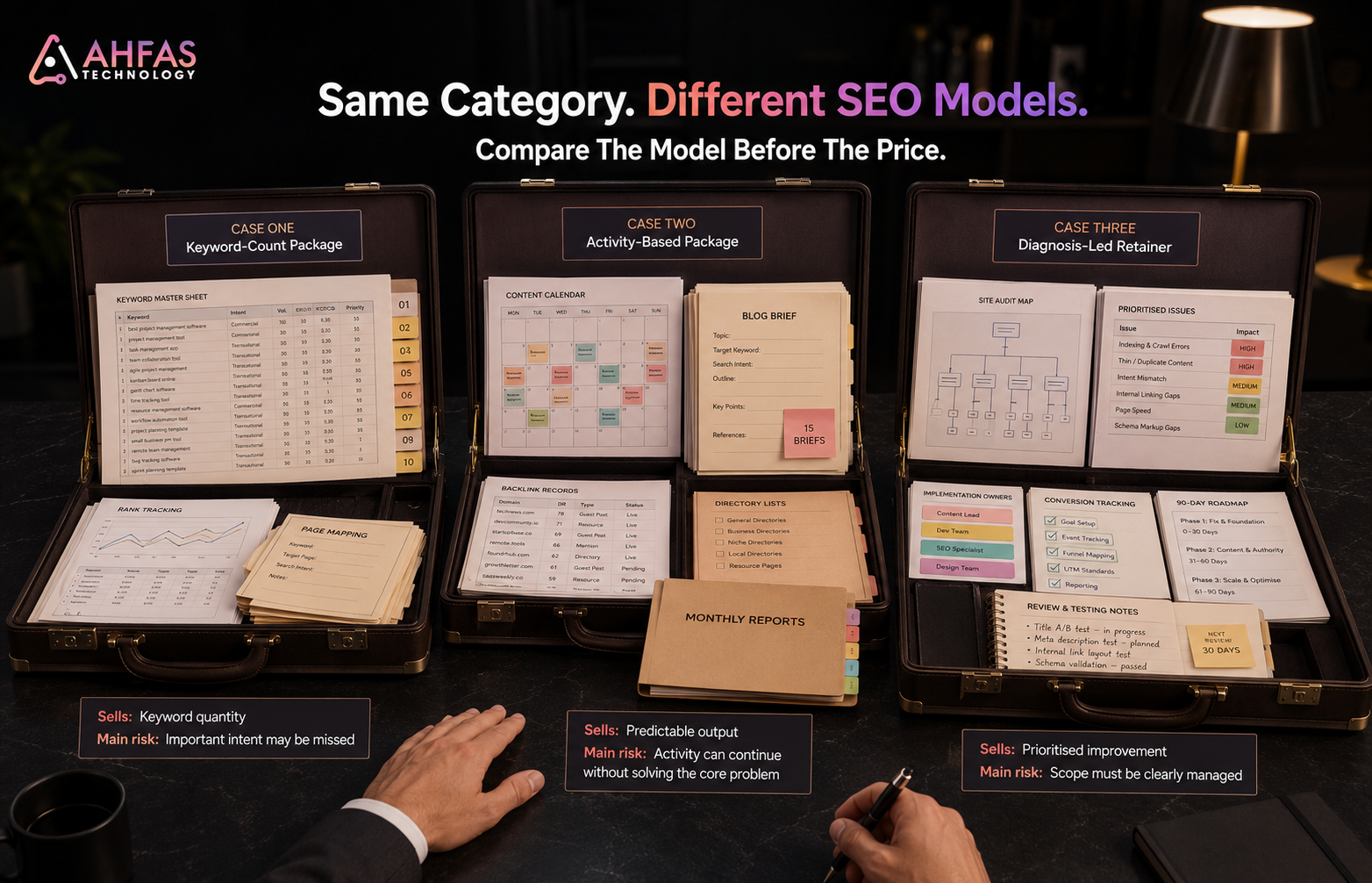
| Package Model | What It Usually Sells | Best Fit | Main Risk |
| Keyword-count package | A fixed number of targeted or tracked keywords | Small websites with narrow services and limited competition | Important search intents or pages may be ignored |
| Activity-based package | Blogs, backlinks, directory listings, reports, and page updates | Businesses needing predictable output | Activity may continue without solving the main problem |
| Diagnosis-led retainer | Audit, priorities, implementation, content, testing, and reporting | Competitive, technical, growing, or multi-service websites | Scope and communication must be clearly managed |
A fixed package is not automatically bad.
The problem begins when an agency recommends the same package to every business without first checking the website.
A clinic, ecommerce store, real estate company, B2B provider, restaurant, and multi-location company do not need identical SEO plans. Their customers search differently. Their websites have different technical risks. Their conversions happen through different paths.
The AHFAS 100-Point SEO Package Reality Check
Use this scorecard to compare different proposals consistently.
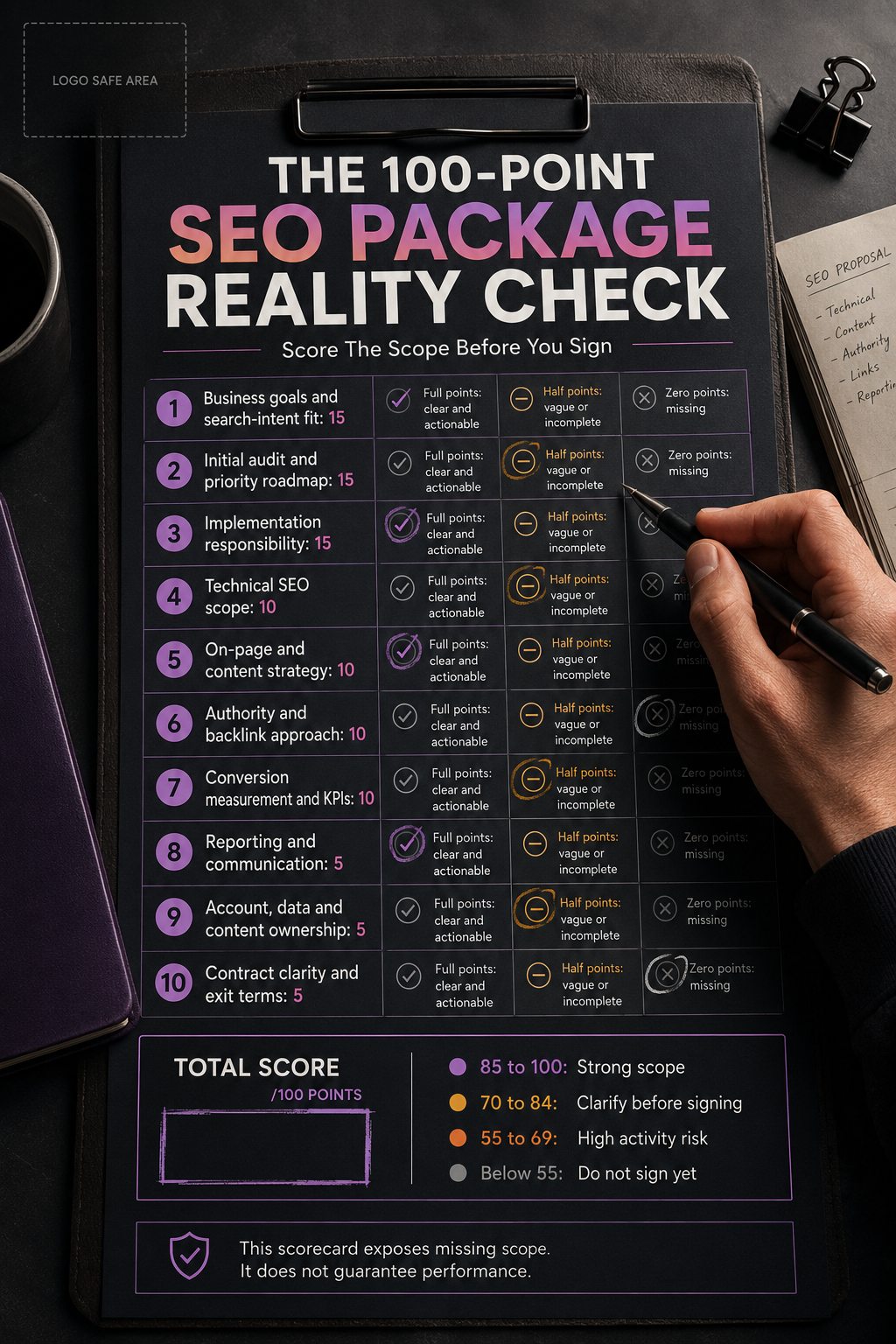
Give each proposal:
- full points when the scope is clear, relevant, and actionable
- half points when the wording is vague or incomplete
- zero points when the item is missing
| Evaluation Area | Weight |
| Business goals and search-intent fit | 15 |
| Initial audit and priority roadmap | 15 |
| Implementation responsibility | 15 |
| Technical SEO scope | 10 |
| On-page and content strategy | 10 |
| Authority and backlink approach | 10 |
| Conversion measurement and KPIs | 10 |
| Reporting and communication | 5 |
| Account, data, and content ownership | 5 |
| Contract clarity and exit terms | 5 |
| Total | 100 |
How to Interpret the Score
85 to 100 points: Strong scope with clear execution, ownership, and accountability.
70 to 84 points: Potentially suitable, but clarify vague or missing areas before signing.
55 to 69 points: High risk of paying for activity without enough strategy or implementation.
Below 55 points: Do not sign until the provider rebuilds or explains the proposal.
This scorecard cannot guarantee performance. It helps expose missing scope, unclear responsibilities, and misleading package comparisons.
1. Does the Package Start With Your Business Goals?
A serious SEO proposal should explain what the campaign is trying to change.
Possible goals include:
- generating calls for a Karachi service business
- attracting qualified enquiries
- increasing ecommerce category traffic
- improving Google Maps visibility
- reducing dependence on paid advertising
- growing non-branded search traffic
- fixing crawling or indexing problems
- supporting a new service or location
- improving visibility in Google AI features
- increasing sales from high-intent landing pages
“Improve rankings” is not a complete business goal.
A keyword can rank without generating a lead. Traffic can increase while sales stay flat. A report can look positive while the website attracts the wrong audience.
The agency should ask about:
- your most profitable services
- priority products or locations
- ideal customers
- current lead sources
- average sales cycle
- margins and capacity
- seasonal demand
- previous SEO work
- direct competitors
- website limitations
- existing conversion data
Google’s updated guidance for hiring an SEO advises businesses to choose providers who are interested in their business, customers, market, competitors, and overall goals.
If an agency recommends a package before asking meaningful questions, it may be selling a standard product instead of solving your problem.
2. Does the Package Include a Real SEO Audit?
The first stage should identify what is actually holding the website back.
A useful baseline review may include:
- crawling and indexing
- Google Search Console data
- technical errors
- website architecture
- internal links
- page quality
- keyword and intent mapping
- content gaps
- duplicate or competing pages
- backlink profile
- Google Business Profile
- local citations
- page experience
- conversion tracking
- competitor visibility
A tool-generated PDF is not automatically an SEO audit.
Tools can identify possible symptoms. An experienced strategist still needs to decide:
- which issue matters
- how serious it is
- what should be fixed first
- what requires development
- what can wait
- how the issue affects visibility or conversions
Google’s June 2026 guidance on third-party SEO tools and services states that third-party tools do not have access to Google’s internal ranking data and cannot guarantee performance.
If your page is already indexed but rarely appears for valuable searches, the problem may involve search intent, weak content, authority, technical quality, or internal competition. The AHFAS guide on a website that is indexed but not ranking explains this difference in more detail.
Request a 30, 60, and 90-Day Roadmap

The proposal should show what happens during the early campaign.
First 30 Days
- access and tracking review
- technical and content audit
- baseline performance recording
- keyword and intent mapping
- urgent error correction
- conversion tracking setup
- core-page prioritisation
Days 31 to 60
- technical implementation
- service-page improvements
- internal-linking updates
- content optimisation
- local SEO work where relevant
- new content production
- authority-building preparation
Days 61 to 90
- query and page performance review
- content expansion
- authority-building execution
- conversion-path improvements
- Google Business Profile refinement
- next-quarter priorities
The exact work will differ by website, but the order should make sense.
3. Who Will Implement the SEO Recommendations?
This is one of the most important differences between two apparently similar packages.
Some agencies identify problems but do not fix them.
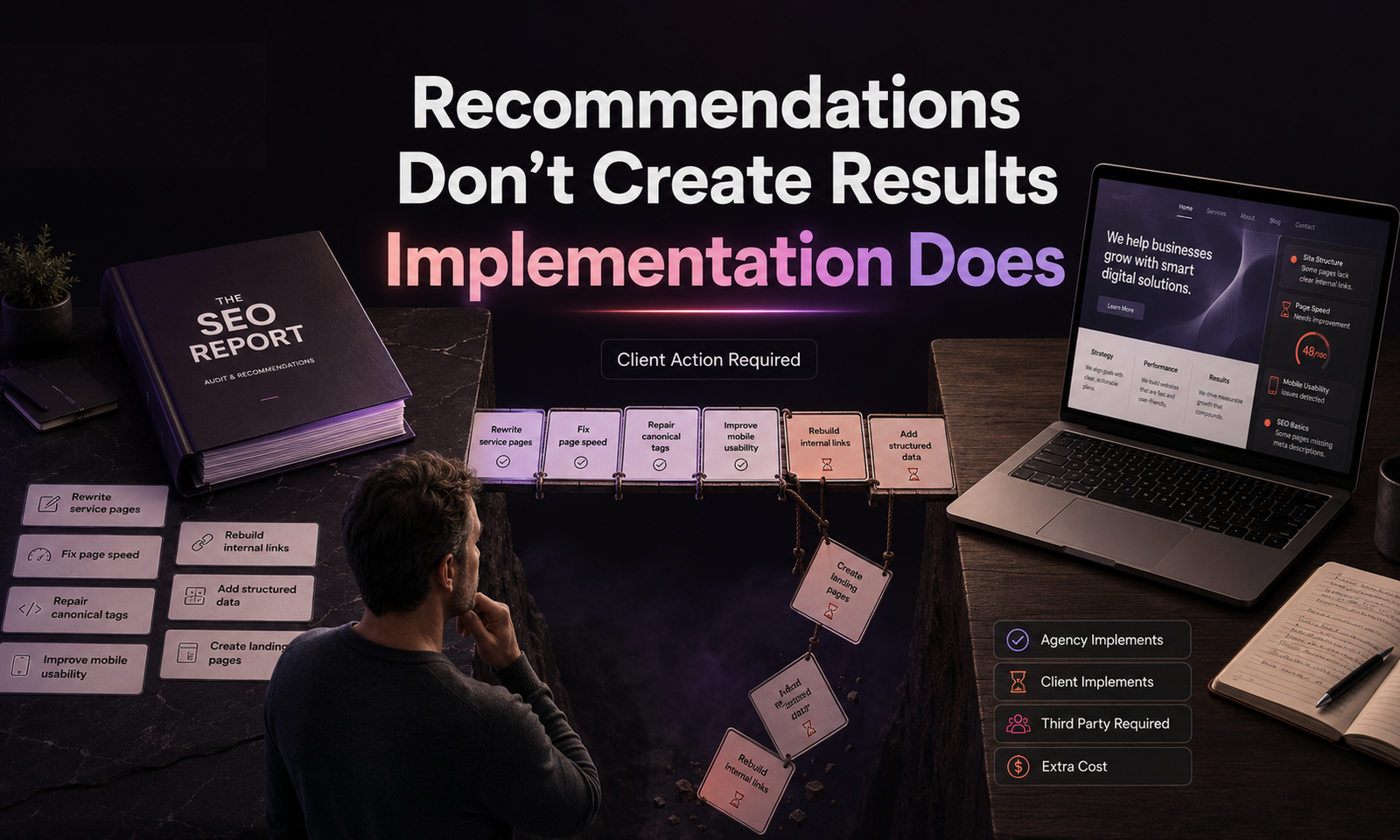
They may recommend:
- rewriting service pages
- improving page speed
- fixing canonical tags
- changing templates
- adding structured data
- rebuilding navigation
- improving mobile usability
- repairing internal links
- creating new landing pages
The monthly report then labels every task as “client action required.”
If your business does not have a developer, writer, designer, or CMS specialist, those recommendations may remain untouched for months.
Ask the provider to label each deliverable as:
- implemented by the agency
- implemented by the client
- handled by a third party
- priced separately
- completed only after approval
When technical fixes require coding or structural changes, confirm whether the package includes implementation or whether you need separate website development support.
A cheaper recommendation-only package can become more expensive after you hire additional specialists to implement the work.
4. What Technical SEO Work Is Included?
“Technical SEO included” is too vague.
The proposal should explain which areas will be reviewed and which problems the agency can fix.
The scope may include:
- crawlability
- indexing
- robots.txt
- XML sitemaps
- canonical tags
- redirect chains
- broken links
- duplicate URLs
- mobile usability
- Core Web Vitals
- page speed
- JavaScript rendering
- structured data
- HTTPS
- server errors
- international targeting
- pagination
- ecommerce filters and faceted navigation
Not every website needs every item.
A five-page company website does not require the same technical programme as a Shopify or WooCommerce store containing thousands of product and category URLs.
Ask these questions:
- Which technical issues have already been identified?
- Which fixes are included in the package?
- Who will implement each fix?
- How will the agency verify completion?
- Will the agency test changes after deployment?
- Which development tasks cost extra?
- Will recurring technical monitoring continue after the first month?
Avoid paying monthly for basic setup tasks that were completed once and never require further action.
5. How Are Keywords Connected to Pages and Search Intent?
Keyword quantity is one of the easiest numbers to inflate.
A proposal may promise 50 or 100 keywords, but those terms could include:
- low-value variations
- irrelevant locations
- searches with little commercial value
- duplicate intents
- keywords already ranking
- phrases with unrealistic competition
- several variations that belong on one page
A stronger proposal groups keywords by intent and maps them to the right pages.
| Keyword Cluster | Search Intent | Suitable Page | Required Action | Business Value |
| Core service searches | Transactional | Service page | Improve or rebuild | High |
| Pricing and package queries | Commercial investigation | Pricing guide or comparison blog | Create supporting content | High |
| Local service searches | Local transactional | Service or location page | Local optimisation | High |
| Problem-based searches | Informational and commercial | Diagnostic article | Create or improve | Medium to high |
| Brand searches | Navigational | Homepage or About page | Strengthen entity clarity | Protective |
Ask the agency to show:
- the keyword cluster
- search intent
- target page
- current visibility
- proposed action
- expected business relevance
You are not paying for a spreadsheet filled with phrases.
You are paying for a strategy that connects search demand to useful pages and business outcomes.
6. What Does the Content Deliverable Actually Include?
“Four SEO blogs every month” tells you almost nothing about quality.
A complete content process may include:
- search-intent analysis
- SERP research
- topic-demand validation
- cannibalisation checks
- subject-matter input
- original examples or frameworks
- primary-source research
- internal linking
- metadata
- expert review
- formatting and uploading
- performance monitoring
- future content updates
- conversion alignment
Google’s people-first content guidance asks whether content provides original information, substantial coverage, useful analysis, trustworthy sourcing, and a satisfying reader experience.
A package that publishes generic articles to meet a monthly quota can create more pages without improving visibility, authority, or leads.
Where content plays a major role in the campaign, confirm whether the package includes only writing or a complete search-intent-led content strategy.
Ask These Content Questions
- Why does this topic deserve a separate article?
- Which query and intent will it target?
- Which service page will it support?
- How will it provide information competitors have missed?
- How will it avoid competing with existing pages?
- Who checks factual accuracy?
- Who adds internal and external links?
- What should the reader do after finishing the article?
- Will weak articles be updated after GSC data becomes available?
Two deeply researched commercial guides can provide more value than eight generic posts.
7. Does the Package Include Local SEO Where Needed?
Karachi service businesses often need more than standard website SEO.
A local package may need to include:
- Google Business Profile review
- primary and secondary categories
- service and business descriptions
- accurate contact details
- review acquisition strategy
- photo guidance
- service-area clarification
- local landing pages
- local citations
- duplicate-profile checks
- Google Maps visibility
- call, website-click, and direction tracking
“Google Business Profile optimisation” should not mean changing the description once and adding a few keywords.
Ask what recurring work happens after the initial setup.
The provider should also understand the difference between:
- a physical storefront
- a service-area business
- a multi-location company
- an online-only company
- a business serving Karachi from another city
Mass directory submissions do not replace a thoughtful local search strategy.
8. How Will the Agency Build Backlinks and Authority?
Backlink numbers can make a package look valuable while hiding serious risk.
A proposal promising 100, 300, or 1,000 monthly links should trigger immediate questions.
Ask:
- Which types of websites will link to us?
- How will relevance be evaluated?
- Will each website be reviewed manually?
- Are the links earned, sponsored, paid, or exchanged?
- Can we approve the target websites?
- Will we receive the live URLs?
- Will the links appear inside genuine editorial content?
- Are automated tools involved?
- Are directories, social profiles, and bookmarks counted as backlinks?
- What happens if a link disappears?
Google’s updated spam policies identify link-buying for ranking credit, automated link creation, excessive exchanges, low-quality directories, and scaled low-value content as practices that can violate its policies.
A responsible authority strategy may include:
- digital PR
- expert contributions
- industry partnerships
- relevant business citations
- useful original research
- high-quality resources
- editorial outreach
- association profiles
- genuine media opportunities
Quality involves relevance, editorial context, reputation, traffic, placement, and acquisition method. The link count alone proves very little.
9. Does the Package Explain AEO, GEO, and AI Search Clearly?
Modern proposals increasingly include terms such as:
- AEO
- GEO
- AI SEO
- AI Overview optimisation
- ChatGPT visibility
- generative search optimisation
These services are not automatically meaningless. The problem begins when an agency uses new terminology without defining the work.
Google’s 2026 guide to generative AI search optimisation states that traditional SEO best practices remain relevant because AI Overviews and AI Mode rely on Google’s core search, retrieval, ranking, and quality systems.
Google also explains that AEO and GEO are commonly used industry terms, but from Google Search’s perspective, optimising for generative search remains part of SEO.
A credible AI-search scope may include:
- improving crawling and indexing
- creating useful, non-commodity content
- strengthening business and entity information
- improving answer clarity
- adding credible sources
- building topical depth
- improving internal linking
- monitoring query fan-out opportunities
- measuring AI-feature visibility
- improving local and structured business information
A vague “GEO optimisation” line with no actions, responsibilities, or measurements should receive no extra value in your comparison.
10. Which KPIs Will the Monthly SEO Report Include?
A ranking report alone is not enough.
Reporting should connect completed work to search visibility, buyer behaviour, and business actions.
| KPI | What It Helps You Understand |
| Non-branded impressions | Whether new audiences are seeing the website |
| Organic clicks | Whether search visibility produces visits |
| Commercial keyword groups | Whether valuable search themes are improving |
| Landing-page performance | Which pages attract and engage search users |
| Calls, forms, messages, or purchases | Whether traffic produces business actions |
| Technical issues resolved | Whether implementation is progressing |
| Content published or improved | Which assets were created and why |
| Google Business Profile actions | Whether local visibility produces calls or directions |
| Assisted conversions | Whether organic search supports longer sales journeys |
| Next-month priorities | What the campaign learned and will do next |
The report should explain:
- what the agency completed
- what changed
- what did not improve
- why it may not have improved
- what the next priority is
- what the client needs to approve
Google advises businesses to ask prospective SEO providers what results they expect, how long those results may take, and how progress will be measured.
11. Who Owns the Accounts, Content, and Data?
Your business should keep control of its digital assets.
The contract should clearly define ownership of:
- website and CMS
- domain
- hosting
- Google Search Console
- Google Analytics
- Google Tag Manager
- Google Business Profile
- written content
- design assets
- keyword research
- reports
- dashboards
- schema and code
- call-tracking numbers
- third-party accounts
- outreach assets
Agency access should normally use individual accounts or partner permissions. Do not hand over the only master login unless there is a valid and documented reason.
When the contract ends, you should receive:
- final reports
- content files
- account-access records
- pending-work status
- change logs
- documentation
- account transfers
- removal of unnecessary agency access
Avoid agreements that make your website, data, or business profiles dependent on accounts the provider refuses to transfer.
12. Are the Monthly Contract Terms Clear and Fair?
SEO usually requires sustained work, but that does not justify vague or one-sided contracts.
Review:
- initial contract duration
- renewal terms
- cancellation process
- notice period
- payment schedule
- pause options
- scope-change process
- additional charges
- revision limits
- development exclusions
- communication schedule
- approval responsibilities
- ownership clauses
- confidentiality
- subcontracting
- handover requirements
Be cautious when:
- the agreement renews without clear notice
- cancellation requires an excessive notice period
- the provider can change deliverables without approval
- additional development charges remain undefined
- the provider owns your content or data
- no final handover process exists
- promised deliverables appear only in sales messages, not the contract
Even when a six or twelve-month agreement is reasonable, ask for a written 90-day plan and regular review points.
For high-value contracts, ask a qualified legal professional to review the final agreement.
SEO Package Red Flags
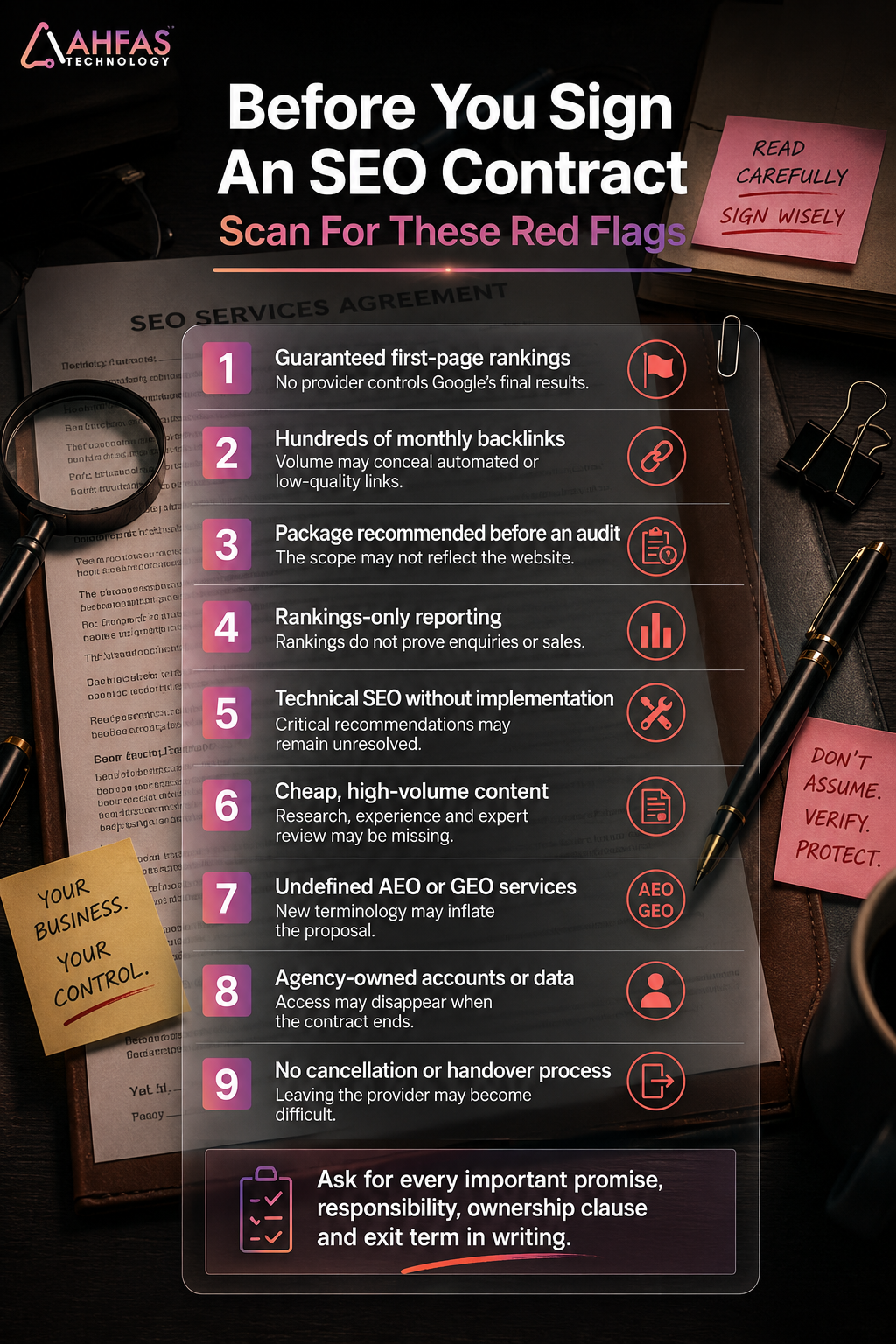
| Red Flag | Why It Matters | What to Ask |
| Guaranteed number-one or first-page rankings | No provider controls Google’s final results | Which outcomes can you realistically influence? |
| Hundreds of backlinks every month | Quantity may hide automated or low-quality links | Show the acquisition process and sample websites |
| Package recommended before an audit | The scope may not reflect your actual problems | Why does this plan fit our website? |
| Ranking-only reports | Rankings may not create leads or sales | How will conversions be tracked? |
| Technical SEO without implementation | Important recommendations may remain unresolved | Who will make the changes? |
| Cheap, high-volume content | Research and expert review may be missing | Who writes and reviews the content? |
| Secret SEO methods | Your website carries the risk | Explain each tactic before receiving access |
| Special relationship with Google | Google does not sell organic rankings | What does the claimed status actually cover? |
| AEO or GEO with no defined actions | New terminology may inflate the proposal | List the exact deliverables |
| Agency-owned accounts | You may lose access when the contract ends | Confirm ownership in writing |
| No cancellation or handover process | Leaving the provider may become difficult | Explain the exit process before signing |
Real-World Case Study: Why Diagnosis Matters More Than Deliverable Counts
Google’s official Saramin SEO case study shows why SEO cannot be reduced to keyword counts and monthly backlinks.
Saramin, a major employment platform in Korea, first used Google Search Console to identify crawling errors and improve indexing.
Google reported that the company achieved:
- a 15% initial increase in organic traffic after addressing crawl errors
- a 102% year-over-year increase in organic traffic during peak hiring season
- a 93% increase in new registrations from organic search traffic
- a 9% year-over-year increase in the organic conversion rate
These results are historical and do not represent a promise, average, or benchmark for Karachi businesses.
The case study demonstrates the important principle:
Meaningful SEO progress came from diagnosis, implementation, monitoring, technical improvement, structured data, and user experience working together.
A package focused only on publishing articles or generating links could have missed the foundational crawling problem.
Which SEO Package Fits Your Business Type?
| Business Type | Scope That Usually Matters Most |
| Local clinic or service company | Google Business Profile, service pages, reviews, local relevance, calls, and location visibility |
| Ecommerce store | Technical architecture, categories, product indexing, internal links, content, and revenue tracking |
| B2B company | Service pages, problem-led content, commercial queries, trust signals, and lead attribution |
| New website | Technical foundation, keyword architecture, core pages, tracking, and early authority building |
| Established website losing traffic | Historical data, technical review, content quality, cannibalisation, and update strategy |
| Multi-location business | Location structure, business profiles, local pages, NAP consistency, and review management |
| International business | Regional targeting, hreflang where appropriate, technical structure, and market-specific content |
| Business needing immediate enquiries | SEO foundation plus an honest comparison of SEO versus Google Ads |
The package should reflect your business model, market, website condition, and timeline. Company size alone should not determine the plan.
Questions to Ask Before Signing an SEO Contract
Use these questions during the proposal call:
- What did you find during the initial website review?
- Why does this package fit our website and market?
- Which services, products, and locations will you prioritise?
- Which pages will target our most valuable search intents?
- What will happen during the first 30, 60, and 90 days?
- Which changes will your team implement directly?
- Which tasks require our developer, writer, or approval?
- How do you research and review content?
- How will backlinks or mentions be acquired?
- Which KPIs will you report beyond rankings?
- How will calls, forms, WhatsApp enquiries, or sales be tracked?
- Who owns the website content, accounts, and data?
- Which team members will work on the campaign?
- How often will we communicate?
- What happens when priorities change after the audit?
- What work is excluded from the monthly fee?
- What happens when the contract ends?
- What do your AEO or GEO deliverables actually include?
- How do you check tactics against Google’s official guidance?
- Can you provide relevant and verifiable work examples?
A credible provider should answer clearly rather than treating reasonable questions as resistance.
Copy-Ready SEO Contract Checklist
Before signing, confirm that the proposal or agreement contains:
- defined business goals
- target services, products, and locations
- baseline audit
- keyword and page mapping
- first 90-day roadmap
- technical SEO scope
- implementation responsibilities
- content quality standards
- local SEO scope where relevant
- backlink acquisition method
- reporting metrics
- conversion tracking
- communication schedule
- named account contact
- approval process
- excluded work
- additional pricing rules
- content and account ownership
- cancellation and renewal terms
- final handover process
Do not rely on promises made only during a sales call. Important commitments should appear in writing.
Final Thoughts
The best way to compare SEO packages Karachi agencies offer is to look beyond keyword counts, backlink numbers, and polished package names.
Compare the diagnosis, implementation, content quality, measurement, ownership, and contract terms. The right package should make the work clearer before asking you to commit.

Comparing proposals right now? Send AHFAS the SEO packages you are reviewing and get a scope-first assessment before signing a monthly contract.
Frequently Asked Questions
What should a good SEO package in Karachi include?
A strong package should include an audit, keyword and intent mapping, technical SEO, on-page optimisation, content planning, internal linking, relevant authority work, conversion tracking, reporting, and an implementation plan. The exact scope should match the website, competition, market, and business goals.
How much do SEO packages cost in Karachi?
Public prices reviewed in July 2026 ranged from approximately PKR 15,000 to PKR 150,000 per month, while some Karachi providers used USD pricing. Actual cost depends on competition, website size, technical condition, content requirements, locations, implementation, and campaign depth.
Is the cheapest SEO package suitable for a small business?
It can be suitable when the scope is focused, competition is manageable, and exclusions are clear. A cheap package becomes expensive when it targets irrelevant keywords, produces weak content, builds risky links, or leaves important fixes unimplemented.
How many keywords should an SEO package target?
There is no ideal number. The right number depends on the business’s services, products, locations, pages, search demand, and budget. Keyword groups should map to relevant pages and commercial goals instead of being selected to inflate the package.
Should an SEO agency guarantee first-page rankings?
No. Google states that no provider can guarantee a number-one ranking. A responsible agency should explain what it can influence, provide realistic expectations, show its planned work, and measure progress without promising an outcome it does not control.
Are monthly backlinks necessary?
Authority building can help, but a fixed backlink quantity is not automatically useful. Relevance, editorial quality, acquisition method, placement, and risk matter more than volume. Some websites need technical or content improvements before link acquisition becomes the priority.
Should content writing be included in the package?
Content should be included when the strategy requires new or improved pages. Confirm whether the fee covers research, writing, expert review, internal linking, revisions, uploading, images, metadata, and performance updates. A monthly article count alone does not prove quality.
What should an SEO monthly report show?
A useful report should explain completed work, organic clicks, impressions, valuable keyword groups, landing-page performance, conversions, technical fixes, content changes, local actions, lessons learned, and the next month’s priorities.
How long should an SEO contract last?
There is no universal contract length. SEO often requires consistent work, but the agreement should include clear milestones, review points, ownership clauses, cancellation terms, and a defined 90-day plan. Avoid long commitments when the scope remains vague.
Is AI search optimisation now part of SEO packages?
It can be, but the provider should define the deliverables. Useful work may include crawlability, expert content, entity clarity, answer quality, reliable citations, structured business information, and AI-feature measurement. Be cautious of unsupported AEO or GEO promises.